Google
 

08 June 2011

Palin's Gaffe and Her Apologists

It’s so important for Americans to learn about our past so we can clearly see our way forward in challenging times; so, we’re bringing attention to our great nation’s foundation.
Sarah Palin, SarahPAC
The news has slowed concerning former Alaska Governor Sarah Palin's gaffe, and some of what was there in the beginning seems gone.

The Boston Herald offered this passage in a much copied article:
But Cornell law professor William Jacobson, who asserted last week that Palin was correct, linking to Revere quotes on his conservative blog Legalinsurrection.com, said Palin’s critics are the ones in need of a history lesson. “It seems to be a historical fact that this happened,” he said. “A lot of the criticism is unfair and made by people who are themselves ignorant of history.”
"Experts Back Sarah Palin's Account"
It's a compelling quote. As Jacobson is a law professor at an elite university, I eagerly went to his blog seeking an able explanation and defense of this judgement: Palin's remarks are more accurate than those of her critics.

Searching for this quote, or even the word "ignorant" in Jacobson's blog bears no fruit. Perhaps the quoted lines are from an interview. Perhaps they originally appeared in the post obliquely referenced, but edits removed them.

Jacobson has several posts over the past few days:

"So Now All These People Will Apologize to Sarah Palin About Paul Revere, Right?" 3 June 2011

Noting that Palin's version "seemed odd," Jacobson found that Conservatives4Palin had quoted Paul Revere's 1898 letter and repeats their quote.

“I'm not a potted plant. I'm here as the blogger. That's my job.” 4 June 2011

He takes issue with a comment on his blog that accused him of "offering cover" to a politician who deserves scorn.

"Deranged Propagandist"
4 June 2011

Notes that Andrew Sullivan linked to his blog via the label "deranged propagandist".

"Anti-Palinites Go All In On Epistemic Closure," 6 June 2011

Renders accusations against Palin's critics for committing the errors they attempt to pin on her.
The debate also shifted, from she was wrong as to the fact of the warning to she was wrong as to Revere's intent. The goal posts constantly were moved. All in all, there was an intellectual shut down by those on the left and right who don't like Palin, an unwillingness to consider facts which contradicted their narrative.
"Suffolk Univ. History Prof. - Palin Right About Paul Revere," 6 June 2011

Links to the NPR interview with Robert Allison that I discuss in "Paul Revere's Bells".

"I Demand That Obama Recite The Longfellow Poem From Memory," 8 June 2011

Clever turn of the whole controversy against our current President.


Paul Revere's Ride


In his first post, Professor Jacobson searched David Hackett Fischer's Paul Revere's Ride (1994) for "Paul Revere bells and gunshots," finding this passage: "A townsman remembered that 'repeated gunshots, the beating of drums and the ringing of bells filled the air'" (150). Something along those lines was my second response (after finding Revere's letter) and I bought the eBook from Google. I started reading it from the beginning, but jumped forward to the passages relevant to Palin's version.

The text read fine on my notebook and desktop computers, but Google's iPad app utterly failed after purchasing the book. After nearly twenty-four hours of frustration, I deleted the app, then reinstalled it. Last night I was able to read Fischer's book as I fell asleep. His description of General Thomas Gage's frustration with colonials seems apropos. If Gage's view has any credibility as Fischer presents it, his observation of colonial contradictions establishes a stronger connection between today's Tea Partiers and the original Boston Tea Party.
General Gage reminded himself that most of these infuriating provincials were British too--blood of his blood, flesh of his own freeborn nation. They had been allowed more liberties than any people on the face of the globe, yet they complained that he was trying to enslave them. They were taxed more lightly than the subjects of any European state, but refused even the trivial sums that Parliament had levied upon them. They professed loyalty to their rightful Sovereign, but tarred and feathered his Royal officers, and burned His Majesty's ships to the water's edge.
Paul Revere's Ride, 31
That a tax revolt might be led by those who paid the least taxes seems as true of the eighteenth century Boston smugglers who organized the Tea Party as of those that lead today's group that claims their mantle.

07 June 2011

Paul Revere's Bells

…he who warned the British that they weren’t gonna be takin’ away our arms, uh, by ringin’ those bells and, um, makin’ sure as he’s ridin’ his horse through town to send those warning shots and bells that we’re gonna be secure and we were gonna be free. And we we’re gonna be armed.
Sarah Palin
Former Alaska Governor Sarah Palin's comment about Paul Revere warning the British and ringing bells went viral over the past weekend. Many heap scorn upon her for ignorance, but others have sought to spin her remarks in a way that presents them as free of essential error. Most Americans in 1775 considered themselves British, or at least British subjects (Paul Revere was the son of a French Huguenot father and an English mother).

Palin's defiance when her history was challenged by FOX's Chris Wallace, feeble though his challenge was, has been reposted as often as her original remarks. Typical of the scorn for Palin's version and the subsequent efforts of her fans to alter Wikipedia is Business Insider:
Paul Revere was "warning the British" that night, Palin says, refusing to admit that she just worded her riff badly. ... [Palin's fans] tried to add citations to support the idea that Revere "rang bells" on his ride. (He didn't).
"Sarah Palin Fans Trying To Rewrite Wikipedia History Of Paul Revere's Ride To Match Her Crazy Version," http://www.businessinsider.com/sarah-palin-fans-try-to-rewrite-wikipedia-history-of-paul-reveres-ride-2011-6
On the other hand, National Public Radio, served up a story that supports her views. Melissa Block interviewed historian Robert Allison, chair of history at Suffolk University in Boston.
Prof. ALLISON: Well, he's not firing warning shots. He is telling people so that they can ring bells to alert others. What he's doing is going from house to house, knocking on doors of members of the Committees of Safety saying the regulars are out. That is, he knew that General Gage was sending troops out to Lexington and Concord, really Concord, to seize the weapons being stockpiled there, but also perhaps to arrest John Hancock and Samuel Adams, leaders of the Continental Congress, who were staying in the town of Lexington.
...
BLOCK: So you think basically, on the whole, Sarah Palin got her history right.
Prof. ALLISON: Well, yeah, she did. And remember, she is a politician. She's not an historian. And God help us when historians start acting like politicians, and I suppose when politicians start writing history.
How Accurate Were Palin's Paul Revere Comments? http://m.npr.org/news/U.S./137011636
For the most part, Allison's comments are consistent with David Hackett Fischer's account in Paul Revere's Ride (1994), probably the best single reference for events in the life of Paul Revere.
[O]nce in the town of Medford, [Revere] went quickly about the task of awakening that community with remarkable economy of effort. He rode directly to the house of Captain Isaac Hall, commander of Medford's minutemen, who instantly triggered the town's alarm system. A townsman remembered that "repeated gunshots, the beating of drums and the ringing of bells filled the air."
Paul Revere's Ride, 140.
There were bells ringing alongside Revere's route, as well as the routes of the other riders. These bells were set off as a consequence of the actions of the riders. Even so, although Revere himself had been a church-bell ringer in his youth and a maker of bells in his profession, he was not ringing the bells himself. He proceeded by stealth. Fischer's narrative offers many a dramatic moment, such as when Revere quietly moved across the mouth of the Charles River and directly under the guns of the warship HMS Somerset (116).

Palin is not crazy to remember bells, but Allison's, "on the whole, Sarah Palin got her history right" seems rather too generous. She botched the story, even though she got some things half-right. If nothing else, the alarm system, the stockpile of cannon and gunpowder, and the ringing of bells all serve to refute Palin's notion that some sort of individual right to bear firearms (as distinct from a "well-regulated militia") was at issue in Paul Revere's midnight ride. The best that can be stated in Palin's defense might be to rate her comments as "barely true," as did PolitiFact. Of the fifty rulings on Palin's statements by this fact-checking resource, twenty-three have scored better than "barely true".

[Addendum 15 August 2011: PolitiFact has changed "barely true" to "mostly false," a better description of what is has meant for a long time. They state at the bottom of the linked page: "Editor's note: This statement was rated Barely True when it was published. On July 27, 2011, we changed the name for the rating to Mostly False."]

Palin's misunderstanding of the minutemen correlates well with her distorted views of eighteenth century New England notions of liberty. Early in Fischer's text, he offers a provocative chiasmus that emphasizes a massive difference in the notions of liberty propagated by today's Tea Partiers and those responsible for the original Boston Tea Party, among whom Revere was one of the leaders.
[Paul Revere] believed deeply in New England's inherited tradition of ordered freedom, which gave heavy weight to collective rights and individual responsibilities--more so than is given by our modern calculus of individual rights and collective responsibilities.
Paul Revere's Ride, 16
The eighteenth century is foreign to modern Americans. Only a deep study of history mired in primary sources will develop the sort of sensibility and understanding needed to translate eighteenth century ideologies into twenty-first century folksy soundbites. There is little in Sarah Palin's background to suggest that she has done this sort of extensive reading, nor that she has any inclination to do so.


Palin quote from Elaine Magliaro, "The Bells are Ringing: Sarah Palin and the Revised Story of Paul Revere's Ride," Jonathan Turley blog (4 June 2011) http://jonathanturley.org/2011/06/04/the-bells-are-ringing-sarah-palin-and-the-revised-story-of-paul-revere's-ride/. Other transcripts of her spoken comments differ slightly. I posted the video of Palin's remarks in yesterday's "Paul Revere's Ride".

06 June 2011

Paul Revere's Ride

Paul Revere's letter to Jeremy Belknap (1798) offers his own account of an event that has been much memorialized, mythologized, and misunderstood in the centuries since. The complete letter is available from the Massachusetts Historical Society.
In Medford, I awaked the Captain of the Minute men; & after that, I alarmed almost every House, till I got to Lexington. I found Mrs. Messrs. Hancock & Adams at the Rev. Mr. Clark's; I told them my errand, and inquired for Mr. Daws; they said he had not been there; I related the story of the two officers, & supposed that He must have been stopped, as he ought to have been there before me. After I had been there about half an Hour, Mr. Daws came; after we refreshid our selves, we and set off for Concord, to secure the Stores, &c. there.
Paul Revere to Jeremy Belknap

Sarah Palin's account differs from Revere's, from accounts by leading historians (David Hackett Fischer's account is cited most often), from Wikipedia before her followers attempted to rectify the omission, and even differs substantially from the account in the not always reliable right-wing history in A Patriot's History of the United States (2004) by Larry Schweikart and Michael Allen. Although a few details that she places near the center of her narrative can be found at the edges of the narrative in A Patriot's History.
[General Thomas Gage] issued orders to arrest the political firebrands and rhetoricians Samuel Adams and John Hancock, who were reported in the Lexington area, and to secure the cannons from the colonists. Gage therefore sought to kill two birds with one stone when, on the night of April 18, 1775, he sent 1,000 soldiers from Boston to march up the road via Lexington to Concord. If he could surprise the colonials and could capture Adams, Hancock, and the supplies quietly, the situation might be defused. But the patriots learned of British intentions and signaled the British route with lanterns from the Old North Church, whereupon two riders, Paul Revere and William Dawes left Boston by different routes to rouse the minutemen. Calling, "To Arms! To Arms!" Revere and Dawes's daring mission successfully alerted the patriots at Lexington, at no small cost to Revere, who fell from his horse after warning Hancock and Adams and was captured at one point, but then escaped.
A Patriot's History, 72-73.
Palin's account garbles these events with half-truths and egregious error, much as Congresswoman Michele Bachmann's placement of Lexington and Concord in New Hampshire brought scorn upon her and raised doubts whether any of the Tea Party leaders know enough American history to pass a high school exam.

Needless to say, my blog feed this morning has listed quite a few references to historians and journalists skewering Palin's account. Ed Brayton asserts, "she babbles like an unprepared freshman in history class." Larry Cebula develops this theme with a clip from Bill and Ted's Excellent Adventure, and also draws attention to revisions of Wikipedia by Palin apologists. He notes, "she tries to fake her way through with the unprepared student's classic recipe of one-half facts that are wrong and one-half trumpeting what the student believes are the key themes of the course." John Fea repeats Andrew Sullivan's harsh psychoanalysis of Palin, "[o]ne of the most pernicious and dangerous features of Palin is her clinical refusal to understand reality, to accept error, to acknowledge when the facts she has cited are not actually facts, but delusions." Sullivan also comments upon Wikipedia vandalism. The Washington Post employs the Wikipedia entry war as its lead to observe the differences between Michelle Bachmann admitting her error and turning into a joke about liberal Massachusetts and Sarah Palin's claim, "I didn't mess up." Kurt Weldon's brief entry offers a memorable line: "Ignorance is not merely bliss--it's mandatory."


Paul Revere and the Second Amendment

Palin's effort to connect Revere to what would become an issue of gun control and interpretations of the Second Amendment does adhere to a theme in some histories.
He who warned, uh, the British that they weren't going to be taking away our arms.
Sarah Palin
Schweikart and Allen note:
[T]he people of Massachusetts established a revolutionary government and raised an army of soldiers known as minutemen (able to fight on a minutes notice).
A Patriot's History, 72
Revere stated clearly that warning the minutemen of British troop movements was his first task.

Schweikart and Allen also position themselves in a debate regarding the extent of firearm and large weapon possession in revolutionary Massachusetts.
[G]uns were so prevalent that citizens did not need to list them specifically. On the eve of the Revolution, Massachusetts citizens were well armed, and not only with small weapons but, collectively, with artillery.
A Patriot's History, 72.
It is clear, even from this pro-gun account from a pair of far-right historians, that Massachusetts established a "well-regulated militia" to serve at the behest of the revolutionary colonial government. Moreover, I rarely hear conservative advocates of the Second Amendment pushing for my right to have an M1A1 Abrams tank in the driveway and surely that is much closer in spirit to the possession of cannon in 1775. Palin seems to want to push this issue a bit farther than Schweikart and Allen, although theirs may be the text that she is misremembering.


Palin's Apologetics

Former Governor Sarah Palin did get something right in a strange twist of fate. In an interview with Chris Wallace on FOX, Palin said:
Reporters don't seem to be understanding it. Even your own Shep Smith there on FOX News, he announced the other day that I was on some publicity tour. I wanted to say, Shep, take it one step futher, what am I publicizing on this tour? I'm publicizing Americana, and our foundation, and how important it is that we learn about our past and our challenges, and victories throughout American history, so that we can successfully proceed forward. Very heady days, rough waters ahead of us, Chris. We need to make sure that we have a strong grasp of our foundational victories so that we can move forward.
Palin to Chris Wallace, FOX News Sunday, at 14:13
She certainly publicizes the need to learn history every time she speaks about the past, for inevitably she makes the news by getting facts mixed up. She then stays in the headlines by insisting that she did not get things wrong. The more she offers her distorted understanding, the more clearly she publicizes the need to learn history. In the long-run that strategy will backfire, but the short-run is her forte.


Palin's English


Finally, we should not overlook this comic piece by Craig Medred in the Alaska Dispatch: "Sarah Palin's Problem is Her English, Not Her History." Palin speaks the rare dialect Northeast Wasillian.
National Rifle Association member that she is, Palin certainly knew Revere wasn't firing off "warning shots.” There were no warning shots in the days of the single-shot, hard-to-reload musket. Nobody wasted shots, let alone ammunition, on warnings. They shot to try to hit something. Palin just slipped up there with her messaging, which is easy to understand because her problem has never been her history so much as her grammar and vocabulary.
...
This is nothing new. Palin has always spoken some form of Wasillian, or even maybe Northeast Wasillian, an extremely rare dialect.
Medred
On a blog that picked up this piece, a commentator noted that Northeast Wasillian is Palin's third language, after "Ida-the-ho-ian and Wasillian."


Editing note: In the original post I incorrectly attributed to John Fea words of Andrew Sullivan that he quoted on his fine history blog. I have corrected the error. Andrew Sullivan is not in my blog feed, while The Way of Improvement Leads Home is one that I read regularly.

06 May 2011

Beware Amazon Marketplace

In 2001 I ordered a book described as new that was priced low. It was the Library of America edition of works by one of America's foremost writers, James Baldwin. My card was charged, but the book never shipped. The dealer, a second-party used dealer in Oregon selling through Amazon, employed several delaying tactics in response to my queries. Amazon told me to contact the dealer directly. They offer this advice up-front, but hide well the process of contacting them directly. Finally, after two months, I demanded a refund from Amazon. Because more than sixty days had transpired since the original order, they refused.

I was furious and resolved to cease all business with Amazon.

It was five years before I relented and bought another book from Amazon--two actually: Chess Bitch by Jennifer Shahade and Breaking Through by Susan Polgar. I had been buying from Amazon nearly monthly prior to this problem. After four years of occasional orders from the online giant, I cautiously placed another order through a second-party dealer. The book arrived as described, and I placed a couple more orders, always making certain that the rating was five-stars and 100%.

Last week, I ordered a book from jwbasilbooks via Amazon. Their rating seemed strong, although a mere 98% going back one year, and down to 93% for the lifetime of their work through Amazon. The order was cancelled the next day.
Greetings from Amazon.com,

We're writing to inform you that your order 002-6768021-8472203 from jwbasilbooks has been canceled because the item(s) you purchased were out of stock. Please return and place your order again at a later time.

Our sellers strive to minimize canceled orders. We're sorry for the inconvenience this has caused. Your credit card was not charged for this order. If you have any questions regarding the cancelation of this order, please contact jwbasilbooks.

If you're still interested in this item, please search for it again on Amazon.com.

from the email
I tried rating the seller because they indicated quite clearly that the item was in stock. I realize that books do go out of stock between the time a book is ordered and when it is packaged for shipping. When the print run is too small on a surprise bestseller, this inconvenience is common. Obscure academic books published half a decade ago, however, do not fly off the shelves. Rather, a bookstore that mines the inventory of other bookstores, as I think is the case for this seller, does not keep its inventory up-to-date. As long as they are selling exclusively through eBay and Amazon, many hundreds or even thousands of cancelled orders will not affect their rating. When they are able to deliver as promised, they get good marks. When they fail, one person knows.

I've ordered the book for a few dollars more from AbeBooks.com. They have yet to fail me.

As I learned back in 2002, Amazon makes efforts to hide the "contact us" option on their website. It took less effort this time--only eight or ten clicks--but I was able to email this note:
It should be possible to rate sellers that cancel orders. I am deeply suspicious that some cancel many orders. A dealer that lists an old and obscure item as in stock, then cancels an order because the item is out of stock SHOULD NOT HAVE A 100% RATING OVER THE PAST 30 DAYS!


Addendum:

Amazon replied to my complaint:
Hello,

I understand that you'd like have the possibility to rate the seller even though the order is canceled

Even though orders canceled by sellers no longer appear in Your Account, you can still leave feedback for sellers who canceled the order by clicking the "Your Account" link on the top right-hand side of the Amazon.com homepage.

Go to the Orders section and click "Leave Seller Feedback".

from the email
jwbasilbooks no longer shows 100%!!

Harpoon Books has processed the order that I placed through AbeBooks. Brian W. Richardson, Longitude and Empire: How Captain Cook's Voyages Changed the World (2005) is on its way.

04 May 2011

The Haymarket Affair: Contrasting Histories

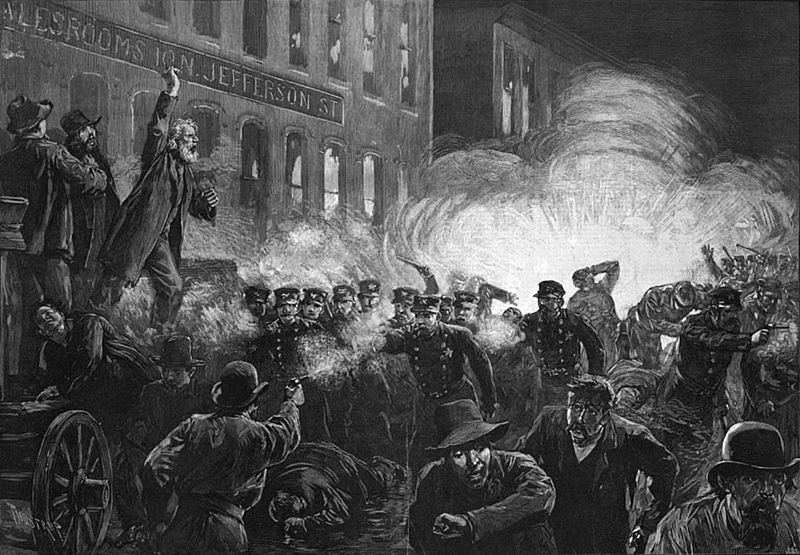
On this day in 1886, thousands of people gathered for a protest rally at Haymarket Square in Chicago. The previous day, police had fired into a crowd of strikers who had been confronting strikebreakers at the McCormick Harvester Works. Two striking workers were killed, perhaps more. The Chicago Daily News reported six deaths, and this figure was repeated by August Spies in his circular calling workers to arms (Paul Avrich, The Haymarket Tragedy [1986], 190).

Howard Zinn reports four deaths in his A People's History of the United States (1980) and quotes part of Spies' leaflet:
Revenge!
Workingmen to Arms!!!
...You have for years endured the most abject humiliations, ... you have worked yourself to death ... your Children you have sacrificed to the factory lord--in short: you have been miserable and obedient slaves all these years: Why? To satisfy the insatiable greed, to fill the coffers of your lazy thieving master? When you ask them now to lessen your burdens, he sends his bloodhounds out to shoot you, kill you!
... To arms we call you, to arms!
as quoted in Zinn, 270-271 (ellipses in Zinn)
This circular was published and distributed the evening of 3 May 1886 and set the stage for tensions the following evening at Haymarket Square. According to Larry Schweikart and Michael Allen, A Patriot's History of the United States (1994), "August Spies set the table for more violence" (439). Schweikart and Allen quote the first three sentences of the circular, "Revenge! Workingmen, to arms! Your masters sent out their bloodhounds!" (439).

Tensions had been building for months. On one side were the police, the state militia, the leaders of industries, a "Citizens' Committee" that met daily to plot strategy. On the other side were members and leaders of labor unions. The Chicago Mail, Zinn tells his readers, had suggested on 1 May watching and making an example of Albert Parsons and August Spies of the International Working People's Association: "Keep them in view. Hold them personally responsible for any trouble that occurs. Make an example of them if trouble occurs" (as quoted by Zinn, 270).

Despite the militant rhetoric, the protest at Haymarket Square was peaceful. As it was nearing its conclusion, 180 police marched towards the speakers stand. Then a bomb exploded, "wounding sixty-six policemen, of whom seven later died" (Zinn, 271). One died instantly (see summary at "The Dramas of Haymarket").

Police reacted quickly to the blast, firing into the crowd, killing at least four demonstrators. There are accounts that suggest many of the wounds suffered by the police were due to friendly fire.


The Chicago History Museum's website offers a good synopsis of the effects of the melee:
Acting with overwhelming public support, the police arrested dozens of political radicals. In the trial that followed, eight anarchists were found guilty of murder. After appeals to the Illinois and United States Supreme Courts failed, four of the defendants were executed on November 11, 1887.
"The Dramas of Haymarket," http://www.chicagohistory.org/dramas/overview/over.htm
Howard Zinn list those executed: "Albert Parsons, a printer, August Spies, an upholsterer, Adolph Fischer, and George Engel" (271). Schweikart and Allen mention the conviction for murder and the governor's pardon of three. A Patriot's History does acknowledge, "trials produced evidence that anarchists only loosely associated with the Knights had been involved" (439). Zinn is more specific:
Some evidence came out that a man named Rudolph Schnaubelt, supposedly an anarchist, was actually an agent of the police, an agent provocateur, hired to throw the bomb and thus enable the arrest of hundreds, the destruction of the revolutionary leadership in Chicago.
Zinn, 271-272.


Patriot's and People's Contrasts

Howard Zinn does not list specific sources for quotations, but has an extensive bibliography for each chapter. Larry Schweikart and Paul Allen source every quotation. Absent from their citations are the standard left-wing labor histories found in Zinn's list, such as Philip Foner, A History of the Labor Movement in the United States, 4 vols. (1947-1964). Neither text cites The Haymarket Tragedy (1986) by Paul Avrich, which was published several years after Zinn's text. Avrich credits the compositor, Hermann Pudewah, for the word "revenge" at the beginning of Spies' circular.

More telling differences emerge in the spin of these two texts. A Patriot's History offers minimal information concerning the labor movement, and credits the well-known Knights of Labor for the protest activities. A People's History crafts a more detailed account of a multitude of organizations, naming Spies' International Working People's Union, one of several engaged in organizing the strike at McCormick Harvester Works. It highlights the struggle for the eight-hour work day, while A Patriot's History manages to discuss union organizing and strikes without naming a single issue. A Patriot's History does manage, however, "High wages also diminished the appeal of organized labor" (438). In contrast, A People's History emphasizes immigrant labor, noting, "There were 5 1/2 million immigrants in the 1880s, 4 million in the 1890s, creating a labor surplus that kept wages down" (266).

  © Blogger templates The Professional Template by Ourblogtemplates.com 2008

Back to TOP