


Patriots and Peoples began with a shopping trip to Borders books. Soon, Borders will be no more. This blog will go on, but how will other brick and mortar stores fare? It seems that I rarely visit Auntie's Bookstore, my local independent. Instead I carry a feed from Amazon in the column highlighting books that I've mentioned recently in this blog. The best bookstore between Seattle and Denver, Bookpeople of Moscow, has an uncertain future now that Bob Greene is retired. Bob often seemed as though he was one of my professors in graduate school in the sense that he frequently recommended books that would illuminate some aspect of problems that I was exploring. His recommendations were usually spot-on, and he was rewarded with a large share of my discretionary income.
Big Box stores do not offer this personal touch. Of course the employees can recommend books, but how often are their recommendations built on knowledge both broad and deep of me as a reader and scholar, and of the worlds of scholarship I tend to inhabit. It helped that Bob's partner was the director of the graduate program in which I was enrolled. But, I get the sense that many of his regular customers in other fields far different had similar experiences. Bob is a man of the world, and a man of books. Barnes & Noble employees seem to be book lovers, but their tastes run to genre literature more often that belles lettres; their knowledge of history seems grounded more in the History Channel than the output of Cornell University Press.
The largest selection of books available for browsing and purchase in Spokane is found at Barnes & Noble near the Spokane Valley Mall, but Barnes & Noble at Northtown Mall is nearer my house. Hastings has a better selection of Culture studies, including historic works by and about American Indians. Trips to Seattle, Bellevue (a Seattle suburb), or to the Tri-Cities usually permit a stop at one of the Barnes & Nobles there, and I'm always pleased to see that Big Box does not always mean the sort of homogenized junk that fills Spokane's stores. Of course, Seattle has much better choices: University Bookstore near the University of Washington (AKA Purple Puppy Pound from the point of view of this Cougar), and Elliott Bay Book Company. David Ishii Bookseller closed in 2005, a loss to the region.
The nearest Borders was handy because it was near the path between home and work. Its selection when it first opened exceeded Barnes & Noble Northtown, but that changed in the recent past. In the first year of its operation, I bought a couple of William Faulkner's texts from this store, but as they sold they were not replaced. Someone else also bought some Faulkner and the selection diminished. The opportunity to browse among a nearly full collection of inexpensive paperbacks by America's best novelist vanished, presumably because the sales were slow.
Borders never had the selection of chess books stocked by Auntie's (thanks to a chess enthusiast working at Auntie's many years), but it was better than Barnes & Noble for awhile. However, the last time I visited Borders, there were two chess books that were not worthless junk, and I reduced their inventory by one-half. I won't miss the absence, nor the time I wasted going in hoping that something had changed.
I'm gonna miss Borders' history section, and their new book tables in the front, and some of the bargain books. I'm gonna miss them a lot less than I would have had they closed four years ago when they had an impressive selection of literature (including Proust and Faulkner), U.S. history that is not military history (including Zinn and Schweikart), chess, and Pacific Northwest history, AKA regional that is not travel guides.
The End of Browsing
Browsing has changed. These days I'm more likely to browse by downloading a Kindle sample. I spent decades developing the ability to pick up a book in a library or bookstore, read the table of contents, examine the notes and bibliography, read the beginnings of a few paragraphs, and make my assessment. Does the work contribute something new? Does the author demonstrate sufficient mastery of his or her topic to warrant the elimination of trees that went into publication? Kindle samples do not permit this sort of analysis, but Google Books previews often do.
I can still browse at Costco, but their selection has deteriorated in the past two years. Before Senator Obama became President Obama, they carried his Dreams from My Father, and John McCain, Faith of My Fathers. Now they seem to have piles of screeds by Glenn Beck and a host of others pushing similar nonsense, but nothing on the other side.
Browsing is one form of reading that often leads to more time in a chair turning pages, growing, learning, thinking. Ebooks take away, or alter, the process of turning pages. But, some fear that ebooks are part an resistible trend away from reading itself. Hundreds of writers are musing over the meaning of the closing of Borders as though the failure of this behemoth is symptomatic of disturbing trends. "Electronic Book: The End for Borders" looks to have been published a few months ago. "Borders Closure and the End of the Book" appeared early this week. Google "borders books end of reading" as I did, and you can find many more.
23 July 2011

18 July 2011
Reagan Mythology
Paul Rosenberg offers an assessment of President Reagan's legacy far more realistic than the one driving Tea Partiers and even President Obama, whom Rosenberg opines, "is as drunk on Reagan's kool-aid as anyone else in Washington today."
He explains,
The article begins:
Hat tip to Millard Fillmore's Bathtub for bringing this editorial to my attention.
He explains,
Reagan was a disaster for the American economy in at least four fundamental ways:
... Under Ronald Reagan, the US went from being the world's largest creditor nation to the largest debtor nation in just a few years
... the number of unionised jobs and the number of jobs with American companies declined even further.
... The income stagnation that began under Reagan has had a devastating impact on personal savings.
... Before Reagan, debt really wasn't a problem for America.
The article begins:
As things stand today, the US is hurtling toward a budget showdown in less than a month. Either President Obama will once again capitulate to extreme Republican budget-slashing demands, making Democrats seem as much of a threat to Medicare as Republicans, and virtually ensuring a GOP electoral sweep in 2012, or the US will default on its debt for the first time in its history, most likely plunging the world economy back into another five-continent recession, also costing Democrats the 2012 elections.Read the rest at Reagan mythology is leading US off a cliff - Opinion - Al Jazeera English
Hat tip to Millard Fillmore's Bathtub for bringing this editorial to my attention.
15 July 2011
Johnny Appleseed
Long, long after,In my pre-teen and early teen years, I read every book presenting American folktales and legends that was available in our little Air Force base library. Some of my favorites included stories of deforestation (Paul Bunyan), the futile battle against mechanization (John Henry), and the introduction of alien plant species (Johnny Appleseed). The books that pulled me into these stories were fanciful and aimed at young readers. The stories were uprooted from their origins as descriptions of actual lives, exaggerated the known facts, and worked into the realm of myth.
When settlers put up beam and rafter,
They asked of the birds: "Who gave this fruit?
Who watched this fence till the seeds took root?
Who gave these boughs?" They asked the sky,
And there was no reply.
But the robin might have said,
"To the farthest West he has followed the sun,
His life and his empire just begun."
Vachel Lindsey, "In Praise of Johnny Appleseed" (1923)
The real Johnny Appleseed died in Indiana in 1845, according to an obituary printed in the Fort Wayne Sentinel (22 March 1845). He was tall, a preacher taken with Emanuel Swedenborg's writings, and planted nurseries rather than spreading seeds willy-nilly. A recent book delves into the myth and known history, making a strong effort to separate the two. Howard Means, Johnny Appleseed: The Man, the Myth, the American Story (2011) offers a detailed biography of the life, activities, and beliefs of John Chapman, the real Johnny Appleseed.
As I remember the stories, I was free to imagine that his seed sowing enterprise took him further west, and that he might have ended his days near present-day Wenatchee. My memory is almost certainly faulty and found its freedom in confusion between the Northwest of early American history--the Ohio Country--and the far Northwest, or Pacific Northwest--a term created by railroad publicists in the late nineteenth century. Even the Disney short, Johnny Appleseed (1948), which I almost certainly watched sometime in the 1960s or early 1970s, places Johnny Appleseed in the Ohio country.

The heart of the Disney film pits cultivation of orchards and promotion of religion against a vast wilderness of dangerous animals. Indians appear on the margins, part of the crowd singing and dancing during the harvest festival. The wary animals first believed the human who moved into a clearing and began to plant seeds was a curious intruder who needed to leave. But, none could tell him so. Finally a skunk went out to investigate and was on the verge of attacking, when Johnny began to stroke its fur. The hero of the story wins over the animals. The narrator emphasizes that he is the first human they had seen without knife or gun. Johnny Appleseed thus fits into the mythic structure of humanity's shift from hunting to cultivation, a reflection of the Neolithic revolution and the rise of civilization. The human story of the beginnings of civilization as long ago as ten millennia ago gets repeated in the New Eden, the American wilderness. See "Neolithic Revolution and American Indians" for another episode in this mythic story.
Apples and Cherries in the Pacific Northwest
Today, Washington state leads the United States in apple production. New York City might be the "big apple," but the apple is more a symbol of the far Northwest than of anywhere else. The apple has become as much a symbol of Pacific Northwest regional culture as the salmon and the seemingly endless evergreen forests. But, while salmon have all but disappeared from every region outside Alaska (and even there the proposed Pebble Mine threatens the last watersheds in full health), and while timber jobs in Washington have become scarce, the apple thrives.
John Chapman never made it this far west. The origins of apples in the Pacific Northwest begin in the Willamette Valley and just over the Columbia River at Fort Vancouver. In the 1820s, the Hudson's Bay Company cultivated many food growing plants from seeds. From these plants, Joseph Garvais cultivated the first substantial apple orchards. Contemporaneous with John Chapman in the Ohio Country, Garvais and other retired Hudson Bay Company employees developed agriculture in Oregon Country.
But it was the introduction of grafted fruit trees that caused the region's agriculture to blossom. These first arrived via wagon along the Oregon Trail courtesy of an Iowa farmer who headed west. In 1847, Henderson Lewelling crossed the country with his family and three wagons. Two of the wagons transported some seven hundred small trees. Once in Oregon, Lewelling went into the nursery business with William Meek. When the gold rush lured Lewelling and Meek to California, where they saw opportunity for more profits developing agriculture, they sold their nursery in Milwaukie, Oregon to Henderson's younger brother, Seth. According to Ronald Irvine, The Wine Project (1997), Meek won an award for wine at the California State Fair in 1859.
Seth Lewelling thrived in the nursery business. His foreman for the orchards, Ah Bing, has been immortalized in the name of a popular fruit that he helped originate. Today, Washington state not only leads the nation in sweet cherry production, but accounts for more than half of the nation's total production.
In the world of legend and myth, everyone knows of Johnny Appleseed. The story of agriculture in the far Northwest, however, offers many less well-known, but every bit as compelling stories of such men as Joseph Garvais, Henderson Lewelling, and Ah Bing.
13 July 2011
Thomas Jefferson: Oenophile
During his first term as President, Jefferson spent seventy-five hundred dollars—roughly a hundred and twenty thousand dollars in today’s currency—on wine, and he is generally regarded as America’s first great wine connoisseur.Thomas Jefferson has long been one of the most interesting American leaders. He wrote the Declaration of Independence with a small amount of editing help from his colleagues. He designed his own home, a marvel of architecture. He argued persuasively with Georges-Louis Leclerc, Comte de Buffon, perhaps the leading theorist concerning evolution a century prior to Charles Darwin, but who made some astounding statements concerning the deficiency of North American air and its lack of large fauna. Jefferson gathered specimens of fauna that dwarfed those in Europe to prove Buffon wrong. Jefferson played the violin, studied languages, experimented with agriculture, and maintained a life-long correspondence with his rival in the most fiercely contested election in the early national period of United States politics, John Adams.
Patrick Radden Keefe, "The Jefferson Bottles"
Thomas Jefferson also loved wine.
In keeping with the focus of Patriots and Peoples, I scanned the indices of A Patriot's History of the United States and of A People's History of the United States for references to Jefferson's oenophilia. The term wine is not indexed in either book, but both contain ample references to Jefferson. Howard Zinn focuses on Jefferson's contribution to politics, saying nothing about his architecture, science, or social views with two exceptions: he credits the spirit of the times rather than personal views of the man for the fact that Jefferson remained a slave owner to his death (see "Thomas Jefferson: Abolitionist?"). The second reference to his cultural values comes in a section concerned with the "cult of domesticity," where Zinn notes Emma Willard contradicting Jefferson's views that women's education should emphasize "the amusements of life ... dancing, drawing, and music" (as quoted in A People's History, 118).
Larry Schweikart and Michael Allen offer a thumbnail sketch of Jefferson the man in A Patriot's History. They mention his interest in wine in a single sentence: "After the war, as American ambassador to France, he developed a pronounced taste for French food, wine, and radical French politics" (133). For much of the targeted audience of the ultra-conservative Patriot's History, this sentence is sufficient to damn Jefferson.
My interest in Jefferson and wine was provoked last week when I started reading The Billionaire's Vinegar (2008) by Benjamin Wallace. There are indications scattered around the web that a film based on Wallace's book is in development. Reports of the movie rights being optioned were released in January 2008 before the book's release. Movie Insider gives 2012 as the tentative date for the movie's release. There's certainly plenty of drama in the story as William Koch spends more than a million dollars hiring former FBI investigators and similar sleuths to build evidence against Hardy Rodenstock, the man behind the sale of dozens of bottles reputedly once owned by Jefferson. Kip Forbes bid 106,000 pounds for the alleged 1787 Château Lafite Bordeaux that instantly became the most expensive bottle of wine in history. Koch spent many thousands less for the bottles that he bought.
The Billionaire's Vinegar opens with a description of the auction where Forbes set a record bid. Much of the story of the auction itself derives from "A Piece of History" in The New Yorker, 20 January 1986. This opening chapter narrates the development of the wine expertise of auctioneer Michael Broadbent, whose opposition to his portrayal later in the book led to a lawsuit that led to Random House agreeing not to distribute the book in the United Kingdom (one wonders whether the film will suffer similar barriers).
The second chapter focuses on Jefferson. I started this book as one of several Kindle samples dealing with history and culture of vitas vinifera cultivation, wine production, and consumption of the beverage that led to Benjamin Franklin's frequently corrupted line, "Behold the rain which descends from heaven upon our vineyards, and which incorporates itself with the grapes to be changed into wine; a constant proof that God loves us, and loves to see us happy!" Freakonomics has a brief entry by the editor of The Yale Book of Quotations (2006), Fred R. Shapiro, concerning the origins of Franklin's quote, the process of authenticating this little detail of the past, and the corruption of Franklin's expression by beer-swilling enthusiasts.
The Kindle sample offers a few pages of this chapter, just enough to hook this angler. I shelled out the $12 needed to get to the end of the chapter and gain access to the notes. Having done so, I read the rest of the book. I learned more about the world of rare wines and forgeries than I had anticipated as among my interests. Having read this book, there's a lot more that I'll be attentive to when the next issue of Wine Spectator arrives in the mail box. Meanwhile, I'm now attending to more Kindle samples:

John Hailman, Thomas Jefferson on Wine (2006)
Charles A. Cerami, Dinner at Mr. Jefferson's: Three Men, Five Great Wines, and the vening that Changed America (2011)
Tyler Colman, Wine Politics: How Governments, Environmentalists, Mobsters, and Critics Influence the Wines We Drink (2008)
Another book of interest is not available as an ebook, but may arrive via the mail in hardcover sometime in the near future.
James Gabler, The Wines and Travels of Thomas Jefferson (1995)
10 July 2011
Washington Wine: An Epicurean History
Missionaries Marcus and Narcissa Whitman lived in the Walla Walla valley 1836-1847. Grapes were among the plantings in their garden, but they were teetotalers and did not make wine. They did, however, observe others drinking local wine during their visits to Fort Vancouver. According to Walter J. Clore's chronology in the appendix of The Wine Project: Washington State's Winemaking History (1997) by Ronald Irvine, the Hudson's Bay Company began growing grapes at Fort Vancouver 1824-1825. These were grown from seeds brought over from England and of unknown variety.
By the time of the Civil War, there were more than 80 varieties of grapes growing in the Walla Walla Valley. Italian immigrant Frank Orselli was selling wine by 1865. In 1876, the Walla Walla Statesman reported that he "has been experimenting in making wine" (Irvine and Clore, 406).
During Prohibition it was legal for a head of household to make 200 gallons of wine per year for personal use. A few commercial winemakers, especially in California, managed to limp along during these dark years making communion wine for the Catholic Church. Two years after the repeal of Prohibition, the Washington Wine Producers Association was established.
In 1960, Walter Clore and associates began grape growing research for Washington State University. This publicly funded research joined forces with private enterprise over the next several decades to develop the largest North American wine industry outside of California. Today, Columbia Valley wines are world renowned and the Walla Walla Valley bustles with tourists during the summer months. They come along the Lewis and Clark Trail, and via other routes, to visit the missionary graves at the Whitman Mission, and they come to sample and buy Washington wines.
My Wine Journey
Like the Whitmans, I spent a couple of years as a teetotaler in the 1980s. Fortunately, that period had come to an end by the time that I attended my first academic conference as a graduate student, the 1989 Pacific Northwest American Studies Association annual conference. It was held at Whitman College, and the Saturday evening banquet began with a bus ride west to Lowden (formerly known as Frenchtown). We had hors d'oeuvres, wine, and dinner at L'Ecole No. 41 winery, Walla Walla's third winery in the modern era. They were just beginning to garner accolades from the international community. I'm fuzzy on some aspects of my personal history, but I might credit the wine I had that evening for the fact that for the better part of the next decade, choosing wine instead of beer or bourbon invariably meant that I would choose a Merlot from Washington state.
I have not had a glass of bourbon since May, and I've drank very little beer. Credit wine. The past few years I've been developing the beginning of some interest in wine, and beginning to educate my palate. Perhaps four years ago, my wife and I sat down with Kevin Zraly, Windows on the World: Complete Wine Course (2007), reading and drinking our way through a glass each of Riesling, Sauvignon Blanc, and Chardonnay. The past few months, I've been rediscovering the wines grown in my home state. I'm learning to pair some of these wines with food. Yesterday, we tasted some wine at the Spokane Public Market and came home with some Bridge Press Cellars Pinot Blanc--a Spokane wine made from Willamette Valley, Oregon grapes.
I'll return to wine history in a future blog post. For now, take a look at this gallery of meals and some of my own recipes.
Food and Wine Gallery
I learned to cook from my mother when I was quite young, and also learned some cooking in the Boy Scouts. In 1975, over a campfire I cooked two dozen eggs over easy without breaking one. In the past two years, I've been learning new cooking methods from Food & Wine Magazine. Recently I started photographing some of my meals and posting the images to Facebook. Many of the recipes come from the magazine. I was surprised, thus, to discover that my pairings with Washington wines rarely featured recipes from this magazine, but from other magazines and cookbooks, and mostly my own inventions. Even so, the influence of Food & Wine is evident in many details.
 In late spring or early summer most years, fresh Copper River salmon becomes available in Spokane grocery stores. I usually buy one fish and get four or five meals--some steaks, some fillets. This year, as the price kept dropping due to an abundant catch, I bought three fish. I butterflied the second one and smoked it on my gas grill. It was topped with a rub of herbs and spices, but I failed to record the mixture. The salad is an old standard of fresh basil from the garden, tomatoes, and mozzarella cheese. I snapped the photo before drizzling the balsamic vinegar. A few spears of asparagus were grilled over the flame on one side of the grill as the salmon finished. These were first sprayed with olive oil and lightly sprinkled with salt and pepper. The wine was a 2008 Waterbrook Melange Noir (less than $15).
Waterbrook Winery was founded in 1984 as Walla Walla's fourth modern winery. When my spouse, my sister and her spouse, my nephew and his girlfriend, and I made our recent pilgrimage to Walla Walla for wine tastings, we began with a wonderful hour on the patio at Waterbrook. This meal with Alaska Sockeye and Washington wine was one month prior to that trip.
 Our second winery on that trip was L'Ecole No. 41, where I had eaten dinner in 1989. My trip there with a bunch of college English and history teachers is the earliest memory that I have of eating dolmades. Since then, I have learned to make them, and they were hors d'oeuvres for the anniversary dinner that I prepared for my wife last month.
Naturally, we tasted and purchased some Merlot when we visited L'Ecole No. 41. We did not start with the Merlot. Prior to the trip, I had been reading Paul Gregutt, Washington Wines and Wineries: The Essential Guide (2007). He praises the success of L'Ecole's Semillon, and we began with that. My wife generally refuses to get interested in any wine that we can see through, but she liked the Semillon. She found the Estate Luminesce exciting! We returned with a couple of bottles of each. When she found some enticing summer recipes in an article in More magazine the following week, I had the beginning of a fine pairing. I made the cold cucumber and honeydew soup from "Picnics for Grownups," pulled an old walleye recipe from America's Favorite Fish Recipes (1992) for some Alaskan cod, and served one of the bottles of Luminesce.
When I started reading Food & Wine, they seemed obsessed with flatiron steak, and I've made a couple of their recipes. After the Fourth of July weekend included some heavy eating with family, we were in the mood for some salads. I made a simple green salad with my own something like Caesar dressing on Tuesday, followed it up with the cucumber soup and cod above on Wednesday, and on Thursday used some of Tuesday's dressing to marinade asparagus and broccoli.
 Something Like Caesar
1 Tbs grated Parmigiano-Reggiano
olive oil (about 4 Tbs)
2 anchovies finely chopped
2 cloves garlic minced
1 Tbs Dijon Mustard
1 Tbs Worcester Sauce
salt and pepper
I put the cheese in the bottom of my salad bowl and cover it with olive oil. Then add the anchovies, garlic, mustard and Worcester Sauce and stir, adding more olive oil until the consistency seems about like bottled Caesar. A little bit of salt and a little more pepper, more stirring, and the dressing is done.
The quantity is too much for one salad feeding two or three people, so I spoon about two-third's of the dressing into a container that goes into the refrigerator. Leaving the portion that I plan to use, I then put my greens on top of the dressing and gently stir. Putting the greens on the dressing and mixing instead of the dressing on the greens is a technique that I've adopted from several recipes in Food & Wine, and from "Chef Bobby Flay's Salad Smarts," a sidebar in Food & Wine Annual Cookbook 2011 (42).
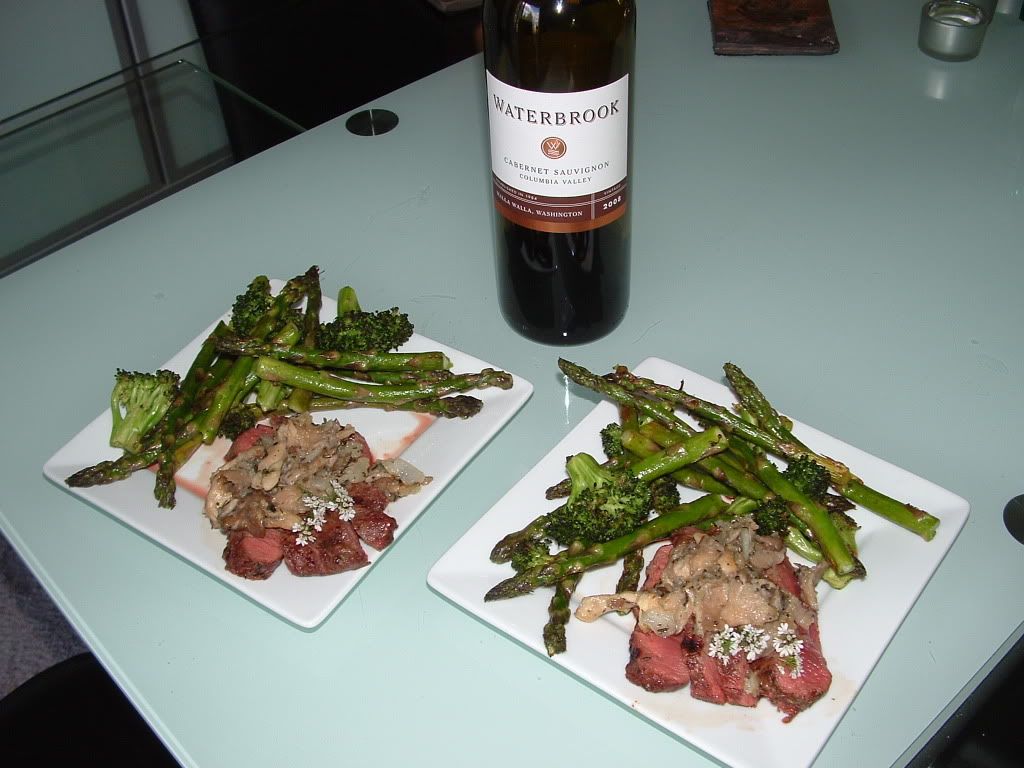
In preparing the asparagus and broccoli dish in the photo, I first retrieved the dressing from the refrigerator and let it come up to room temperature. Then, I prepared the steak marinade by putting a diced onion, rosemary, and sage in the Magic Bullet to mostly liquify. I spread the mixture on the steak and let it sit for an hour or so. I washed the asparagus, breaking off the thickest part of the stems, and washed the broccoli. In a plastic bag, I spooned some of the leftover dressing on the vegetables, closed the bag with plenty of air inside and shook to coat. I let the vegetables sit on the counter for most of an hour.
When it was time to cook, I scraped the onion mixture off the steak. I grilled the vegetables in a grilling basket. When they were nearly done, I started grilling the steak (about four minutes per side). Meanwhile, I sauteed the onions in some olive oil with fresh oyster mushrooms. After removing the steak from the grill, I sliced it, placed four slices on each plate and topped with the mushroom and onion mixture, then plucked a couple of cilantro flowers and set these on top.
The steaks and vegetable mix were served with a bottle of 2008 Waterbrook Cabernet Sauvignon.
At the Spokane Public Market, yesterday, we found some fresh Walla Walla sweet onions, and some lamb steaks from a local farmer. I mixed some dried mint with smaller amounts of cumin, and thyme, sprinkled it on the lamb steaks, and let set an hour.
I quartered half an onion, then sliced it. I sauteed the onion in olive oil until it started to brown, then added one-half cup Moscato wine and cooked until the wine evaporated. Then I added a handful of walnuts that I had roasted in the oven for eight minutes at 350 F.
While the onions and walnuts continued to brown on medium heat, I started the steaks, grilling seven or eight minutes per side. I poured a little white wine vinegar into the pan with the onions and nuts, and cooked until it evaporated. During the last two minutes of cooking the steaks, I threw about three cups of baby spinach leaves into the pan with the onions--stirring constantly until thoroughly wilted.
The lamb and spinach were served with a bottle of Woodward Canyon non-vintage red. The bottle had been opened earlier for the hors d'oeuvres, plank grilled figs with pancetta and goat cheese, a recipe from Epicurious.com. Woodward Canyon was Walla Walla's second modern winery, and it was the third we visited during our pilgrimage. Their non-vintage red was the discovery of the trip--an extremely nice wine for $19 per bottle.
 Our wine budget accommodates very few wines above $20 per bottle, and generally only on special occasions. During a trip to Walla Walla this spring for a work conference, my wife picked up a couple of Spring Valley Vineyard wines that are expensive by our standards. We opened a bottle of 2007 Frederick for our anniversary. I fixed a four-course meal for the occasion. It was a study in pairings.
The first course consisted of dolmades (my recipe) and goat cheese stuffed grape leaves from Food & Wine. To be honest, the $50 bottle of Frederick did not seem particularly impressive with the hors d'oeuvres. It was good, but not great.
The second course was a beet, pickled cheery, and crispy shallot salad from Food & Wine. It clashed with the wine, bringing out bitter flavors.
For the main course, I grilled a Turkish rack of lamb from Jamie Purviance, Weber's Time to Grill (2011). Together with Frederick, the lamb was exquisite and the wine showed its grace and complexity. It was a perfect pairing. After the main course, we were satiated and delayed dessert for a few hours.
Dessert was another Food & Wine recipe, except that I added some goat cheese and nuts. We ate the dessert with a glass of the plum wine used to marinate the plums.
By the time of the Civil War, there were more than 80 varieties of grapes growing in the Walla Walla Valley. Italian immigrant Frank Orselli was selling wine by 1865. In 1876, the Walla Walla Statesman reported that he "has been experimenting in making wine" (Irvine and Clore, 406).
During Prohibition it was legal for a head of household to make 200 gallons of wine per year for personal use. A few commercial winemakers, especially in California, managed to limp along during these dark years making communion wine for the Catholic Church. Two years after the repeal of Prohibition, the Washington Wine Producers Association was established.
In 1960, Walter Clore and associates began grape growing research for Washington State University. This publicly funded research joined forces with private enterprise over the next several decades to develop the largest North American wine industry outside of California. Today, Columbia Valley wines are world renowned and the Walla Walla Valley bustles with tourists during the summer months. They come along the Lewis and Clark Trail, and via other routes, to visit the missionary graves at the Whitman Mission, and they come to sample and buy Washington wines.
My Wine Journey
Like the Whitmans, I spent a couple of years as a teetotaler in the 1980s. Fortunately, that period had come to an end by the time that I attended my first academic conference as a graduate student, the 1989 Pacific Northwest American Studies Association annual conference. It was held at Whitman College, and the Saturday evening banquet began with a bus ride west to Lowden (formerly known as Frenchtown). We had hors d'oeuvres, wine, and dinner at L'Ecole No. 41 winery, Walla Walla's third winery in the modern era. They were just beginning to garner accolades from the international community. I'm fuzzy on some aspects of my personal history, but I might credit the wine I had that evening for the fact that for the better part of the next decade, choosing wine instead of beer or bourbon invariably meant that I would choose a Merlot from Washington state.
I have not had a glass of bourbon since May, and I've drank very little beer. Credit wine. The past few years I've been developing the beginning of some interest in wine, and beginning to educate my palate. Perhaps four years ago, my wife and I sat down with Kevin Zraly, Windows on the World: Complete Wine Course (2007), reading and drinking our way through a glass each of Riesling, Sauvignon Blanc, and Chardonnay. The past few months, I've been rediscovering the wines grown in my home state. I'm learning to pair some of these wines with food. Yesterday, we tasted some wine at the Spokane Public Market and came home with some Bridge Press Cellars Pinot Blanc--a Spokane wine made from Willamette Valley, Oregon grapes.
I'll return to wine history in a future blog post. For now, take a look at this gallery of meals and some of my own recipes.
Food and Wine Gallery
I learned to cook from my mother when I was quite young, and also learned some cooking in the Boy Scouts. In 1975, over a campfire I cooked two dozen eggs over easy without breaking one. In the past two years, I've been learning new cooking methods from Food & Wine Magazine. Recently I started photographing some of my meals and posting the images to Facebook. Many of the recipes come from the magazine. I was surprised, thus, to discover that my pairings with Washington wines rarely featured recipes from this magazine, but from other magazines and cookbooks, and mostly my own inventions. Even so, the influence of Food & Wine is evident in many details.
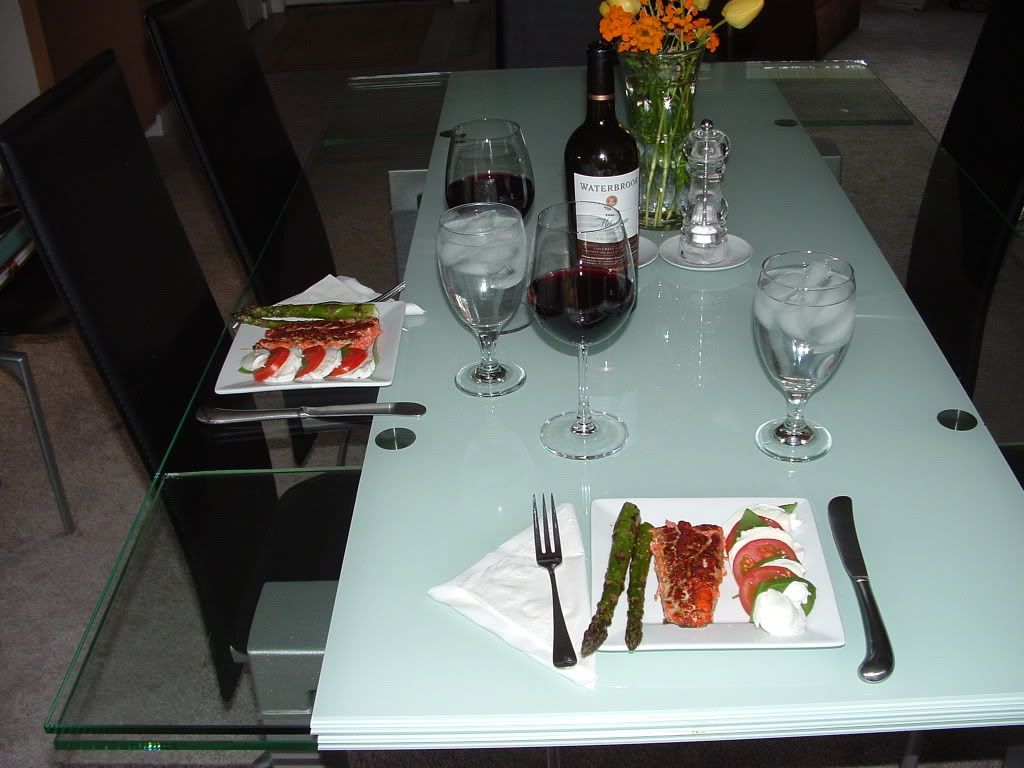 In late spring or early summer most years, fresh Copper River salmon becomes available in Spokane grocery stores. I usually buy one fish and get four or five meals--some steaks, some fillets. This year, as the price kept dropping due to an abundant catch, I bought three fish. I butterflied the second one and smoked it on my gas grill. It was topped with a rub of herbs and spices, but I failed to record the mixture. The salad is an old standard of fresh basil from the garden, tomatoes, and mozzarella cheese. I snapped the photo before drizzling the balsamic vinegar. A few spears of asparagus were grilled over the flame on one side of the grill as the salmon finished. These were first sprayed with olive oil and lightly sprinkled with salt and pepper. The wine was a 2008 Waterbrook Melange Noir (less than $15).
Waterbrook Winery was founded in 1984 as Walla Walla's fourth modern winery. When my spouse, my sister and her spouse, my nephew and his girlfriend, and I made our recent pilgrimage to Walla Walla for wine tastings, we began with a wonderful hour on the patio at Waterbrook. This meal with Alaska Sockeye and Washington wine was one month prior to that trip.
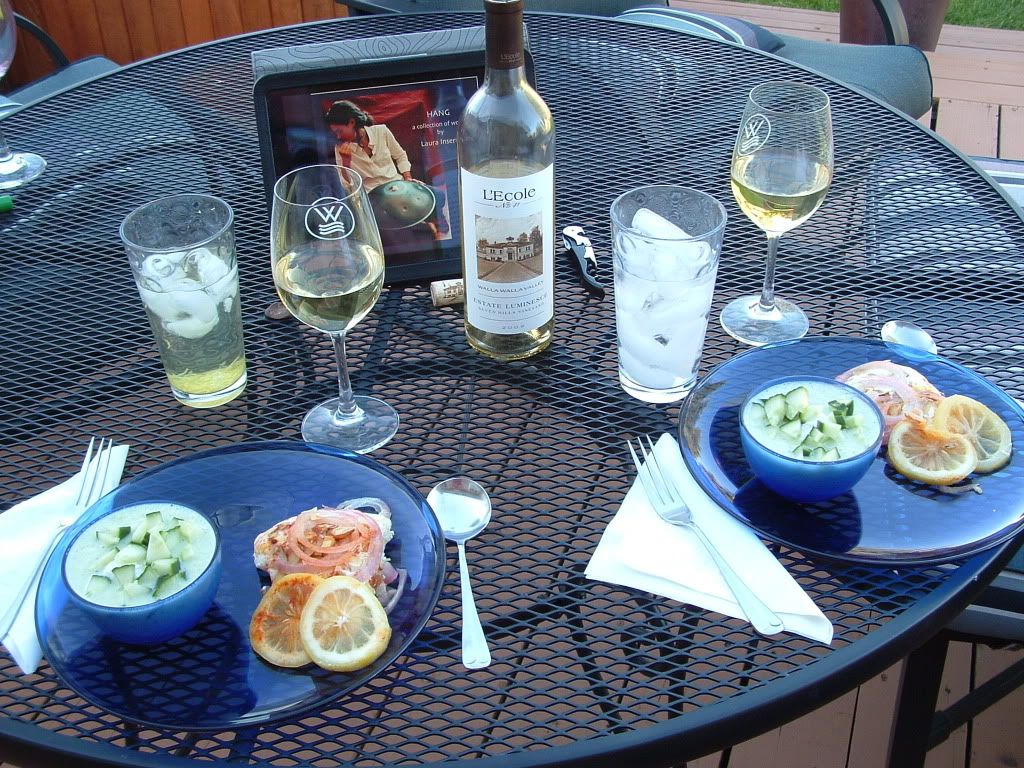 Our second winery on that trip was L'Ecole No. 41, where I had eaten dinner in 1989. My trip there with a bunch of college English and history teachers is the earliest memory that I have of eating dolmades. Since then, I have learned to make them, and they were hors d'oeuvres for the anniversary dinner that I prepared for my wife last month.
Naturally, we tasted and purchased some Merlot when we visited L'Ecole No. 41. We did not start with the Merlot. Prior to the trip, I had been reading Paul Gregutt, Washington Wines and Wineries: The Essential Guide (2007). He praises the success of L'Ecole's Semillon, and we began with that. My wife generally refuses to get interested in any wine that we can see through, but she liked the Semillon. She found the Estate Luminesce exciting! We returned with a couple of bottles of each. When she found some enticing summer recipes in an article in More magazine the following week, I had the beginning of a fine pairing. I made the cold cucumber and honeydew soup from "Picnics for Grownups," pulled an old walleye recipe from America's Favorite Fish Recipes (1992) for some Alaskan cod, and served one of the bottles of Luminesce.
When I started reading Food & Wine, they seemed obsessed with flatiron steak, and I've made a couple of their recipes. After the Fourth of July weekend included some heavy eating with family, we were in the mood for some salads. I made a simple green salad with my own something like Caesar dressing on Tuesday, followed it up with the cucumber soup and cod above on Wednesday, and on Thursday used some of Tuesday's dressing to marinade asparagus and broccoli.
 Something Like Caesar
1 Tbs grated Parmigiano-Reggiano
olive oil (about 4 Tbs)
2 anchovies finely chopped
2 cloves garlic minced
1 Tbs Dijon Mustard
1 Tbs Worcester Sauce
salt and pepper
I put the cheese in the bottom of my salad bowl and cover it with olive oil. Then add the anchovies, garlic, mustard and Worcester Sauce and stir, adding more olive oil until the consistency seems about like bottled Caesar. A little bit of salt and a little more pepper, more stirring, and the dressing is done.
The quantity is too much for one salad feeding two or three people, so I spoon about two-third's of the dressing into a container that goes into the refrigerator. Leaving the portion that I plan to use, I then put my greens on top of the dressing and gently stir. Putting the greens on the dressing and mixing instead of the dressing on the greens is a technique that I've adopted from several recipes in Food & Wine, and from "Chef Bobby Flay's Salad Smarts," a sidebar in Food & Wine Annual Cookbook 2011 (42).
In preparing the asparagus and broccoli dish in the photo, I first retrieved the dressing from the refrigerator and let it come up to room temperature. Then, I prepared the steak marinade by putting a diced onion, rosemary, and sage in the Magic Bullet to mostly liquify. I spread the mixture on the steak and let it sit for an hour or so. I washed the asparagus, breaking off the thickest part of the stems, and washed the broccoli. In a plastic bag, I spooned some of the leftover dressing on the vegetables, closed the bag with plenty of air inside and shook to coat. I let the vegetables sit on the counter for most of an hour.
When it was time to cook, I scraped the onion mixture off the steak. I grilled the vegetables in a grilling basket. When they were nearly done, I started grilling the steak (about four minutes per side). Meanwhile, I sauteed the onions in some olive oil with fresh oyster mushrooms. After removing the steak from the grill, I sliced it, placed four slices on each plate and topped with the mushroom and onion mixture, then plucked a couple of cilantro flowers and set these on top.
The steaks and vegetable mix were served with a bottle of 2008 Waterbrook Cabernet Sauvignon.
At the Spokane Public Market,
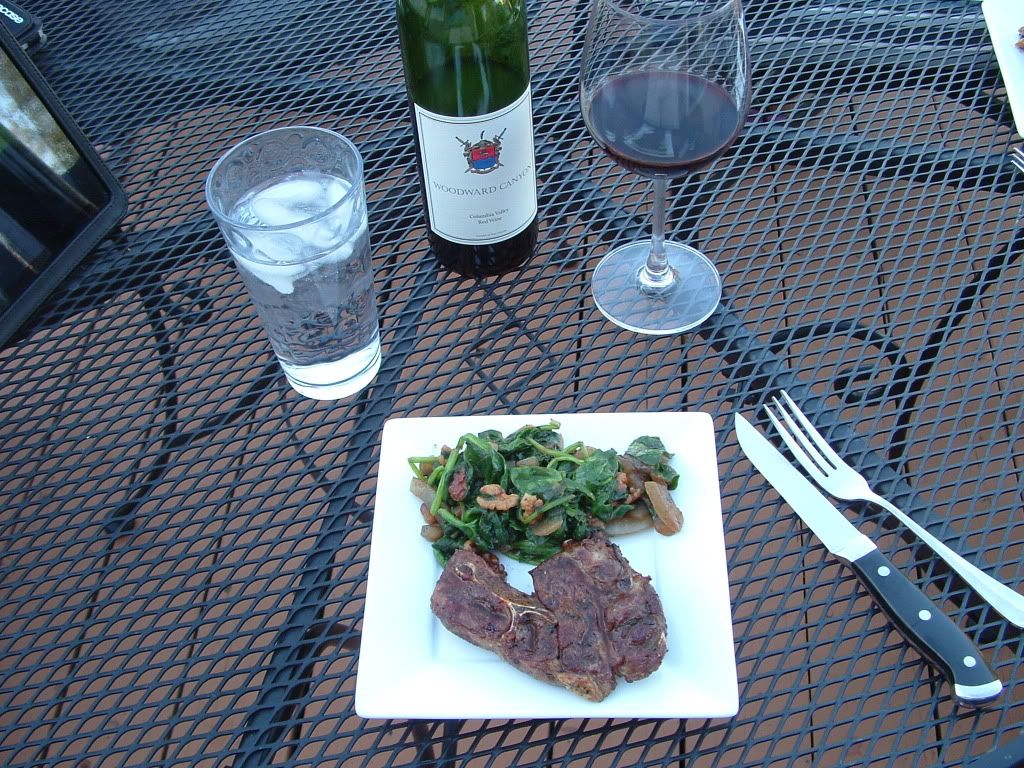 yesterday, we found some fresh Walla Walla sweet onions, and some lamb steaks from a local farmer. I mixed some dried mint with smaller amounts of cumin, and thyme, sprinkled it on the lamb steaks, and let set an hour.
I quartered half an onion, then sliced it. I sauteed the onion in olive oil until it started to brown, then added one-half cup Moscato wine and cooked until the wine evaporated. Then I added a handful of walnuts that I had roasted in the oven for eight minutes at 350 F.
While the onions and walnuts continued to brown on medium heat, I started the steaks, grilling seven or eight minutes per side. I poured a little white wine vinegar into the pan with the onions and nuts, and cooked until it evaporated. During the last two minutes of cooking the steaks, I threw about three cups of baby spinach leaves into the pan with the onions--stirring constantly until thoroughly wilted.
The lamb and spinach were served with a bottle of Woodward Canyon non-vintage red. The bottle had been opened earlier for the hors d'oeuvres, plank grilled figs with pancetta and goat cheese, a recipe from Epicurious.com. Woodward Canyon was Walla Walla's second modern winery, and it was the third we visited during our pilgrimage. Their non-vintage red was the discovery of the trip--an extremely nice wine for $19 per bottle.
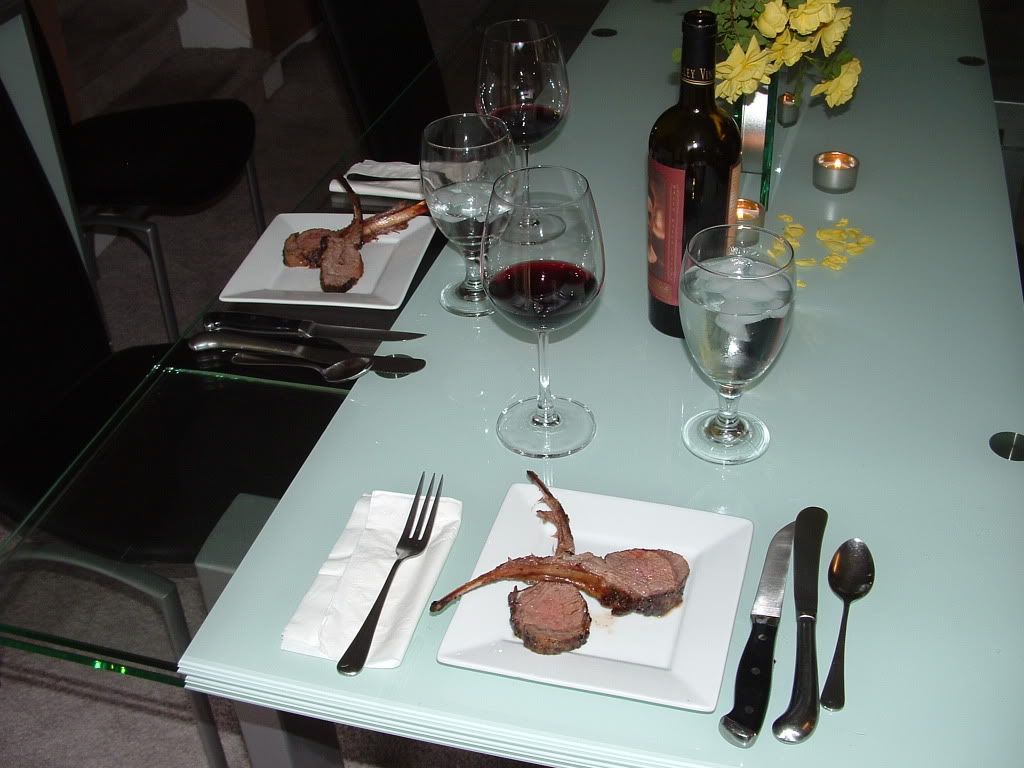 Our wine budget accommodates very few wines above $20 per bottle, and generally only on special occasions. During a trip to Walla Walla this spring for a work conference, my wife picked up a couple of Spring Valley Vineyard wines that are expensive by our standards. We opened a bottle of 2007 Frederick for our anniversary. I fixed a four-course meal for the occasion. It was a study in pairings.
The first course consisted of dolmades (my recipe) and goat cheese stuffed grape leaves from Food & Wine. To be honest, the $50 bottle of Frederick did not seem particularly impressive with the hors d'oeuvres. It was good, but not great.
The second course was a beet, pickled cheery, and crispy shallot salad from Food & Wine. It clashed with the wine, bringing out bitter flavors.
For the main course, I grilled a Turkish rack of lamb from Jamie Purviance, Weber's Time to Grill (2011). Together with Frederick, the lamb was exquisite and the wine showed its grace and complexity. It was a perfect pairing. After the main course, we were satiated and delayed dessert for a few hours.
Dessert was another Food & Wine recipe, except that I added some goat cheese and nuts. We ate the dessert with a glass of the plum wine used to marinate the plums.
Subscribe to:
Posts (Atom)


