Essential Bibliography
What books and articles belong on a short list of essential readings defining history?
Marc Bloch, The Historian's Craft (1953) might make the list. Bloch and Lucien Febvre founded the influential Annales School. Perhaps instead of, or in addition to, The Historian's Craft, the short list should include Peter Burke, ed., A New Kind of History: From the Writings of Lucien Febvre (1973).
I am reasonably certain that the list must exclude Arnold Toynbee, A Study of History, 12 vols. (1934-1961). However, perhaps there is merit to M.F. Ashley Montagu, ed., Toynbee and History: Critical Essays and Reviews (1956).
E.H. Carr, What is History? (1961) certainly belongs on any short list. But what about the responses?
Geoffrey Elton, The Practice of History (1967).
Hugh Trevor-Roper, "E.H. Carr's Success Story," Encounter (1962), 69-77.
Michael Fox, ed., E.H. Carr: A Critical Appraisal (2000).
John Lewis Gaddis, The Landscape of History (2004).
There are dozens of others.
Would it be cheating to list the entire print run of the academic journal History and Theory (1960- )?
I am inclined to leave out Peter Novick, That Noble Dream: The 'Objectivity Question' and the American Historical Profession (1988). This book lacks international scope. But this omission could be an error.
Is there a place on a short list for Herodotus, The Histories (c. 440 BCE)? Thucydides, History of the Peloponnesian War (c.395 BCE)? Tacitus?
The provocative Carl Becker, "Everyman His Own Historian," American Historical Review (1932), 221-236 certainly merits inclusion.
Is there a single text by Leopold von Ranke that would serve to note his contribution to historiography?
Perhaps an important element concerns the practice of history appears with the inclusion of such works as Sam Wineburg, Historical Thinking and Other Unnatural Acts (2001) and Lendol Calder, "Uncoverage: Toward a Signature Pedagogy for the History Survey," The Journal of American History (March 2006), 1358-1370.
History is as much a way of thinking as an object of study.
My short list of no more than a dozen titles remains to be compiled. Suggestions are welcome.
Showing posts with label Historical Thinking. Show all posts
11 July 2014
07 April 2013
Significance
Max Euwe (1901-1981) was a mathematician and the fifth official World Chess Champion. The beginning of his now classic text, The Development of Chess Style (1968)* has a assertion concerning the nature of history and the centrality of questions of significance that is as terse as any I have seen in the writings of professional historians.
*Originally published in Dutch as Veldheersschap op de Vierenzestig (1966)
To suppose that the history of any subject should be just a collection of independent facts is a serious misapprehension. They may, it is true, make interesting reading; but they may also have little significance for the subject in question. "Introduction," n.p.
*Originally published in Dutch as Veldheersschap op de Vierenzestig (1966)
07 January 2013
Sam Wineburg on A People's History
Howard Zinn's A People's History of the United States has few peers among contemporary historical works. With more than 2 million copies in print, A People's History is more than a book. It is a cultural icon. "You wanna read a real history book?" Matt Damon asks his therapist in the 1997 movie Good Will Hunting. "Read Howard Zinn's People's History of the United States. That book'll ... knock you on your ass."
read more at
Where Howard Zinn's "A People's History" Falls Short | History News Network
read more at
Where Howard Zinn's "A People's History" Falls Short | History News Network
28 August 2011
Ben Franklin On Wine
Beer is proof God loves us and wants us to be happy.There are plenty of references to beer in Benjamin Franklin's writings and other papers. His wife, Deborah, mentions beer in a list of household expenses for May 1762. Richard Saunders (one of Franklin's pseudonyms) describes Mead as "the best of Small Beer" (Poor Richard Improved, 1765). In describing objections of the American colonists to the Stamp Act, he noted the "too heavy Duty on foreign Mellasses" interfered in procurement of "one of the Necessaries of Life ... universally a principal Ingredient in their common Beer" (Fragments of a Pamphlet on the Stamp Act). There are also references to Thomas Beer, whom John Adams mentioned, "had been obliged to fly from England, for having assisted American Prisoners to escape" (Adams to Franklin, 18 October 1781).
Attributed to Benjamin Franklin
These references are found easily among the thirty-four to "beer" in the digitized edition of The Franklin Papers at Yale. These papers comprise thirty-nine published volumes and more in the works. A search of the same digital archives produces two hundred twenty-six references to wine.
Ben Franklin's famous quote regarding beer as evidence of God's love appears nowhere in the Franklin Papers at Yale. They do not have the largest collection of his letters. Even so, their digital archive is easy to use, and offers a considerable trove of Franklin's writing.
According to Fred R. Shapiro, editor of The Yale Book of Quotations (2006), the earliest instance of Franklin's beer quote may have been in Beverage World (1 February 1996). This past March, he challenged readers of his Freakonomics column to push that date back earlier with their own research. Shapiro believes, as do many others who have explored the topic, that Franklin's beer quote is a corruption of another less well-known statement regarding divine favor in the watering of the vines that make possible the production of wine.
We hear of the conversion of water into wine at the marriage in Cana, as of a miracle. But this conversion is, through the goodness of God, made every day before our eyes. Behold the rain which descends from heaven upon our vineyards, and which incorporates itself with the grapes to be changed into wine; a constant proof that God loves us, and loves to see us happy! The miracle in question was only performed to hasten the operation under circumstances of present necessity, which required it.This letter appears nowhere in the Franklin papers at Yale. It does appear in a collection of writings put out by William Temple Franklin, executor of Franklin's literary estate. Both the original letter, in French, and an English translation appear in William Temple Franklin, Memoirs of the Life and Writings of Benjamin Franklin, vol. V, 3d ed (London: Printed for Henry Colburn, 1819), pp. 286-291. Google has digitized a copy.
Franklin to Abbé André Morellet
Sourcing
[Lendol] Calder attempts to identify the peculiar signature of the practice of history. He seeks to introduce to his students six "cognitive habits: questioning, connecting, sourcing, making inferences, considering alternate perspectives, and recognizing limits to one's knowledge" (emphasis added).
James Stripes, "Reflective Thinking, Teaching and Learning"
Bloggers often fail to source their work. Politicians fail almost universally. Beer advocates are not particularly prone to verifying that a compelling phrase uttered (or written) by one of America's true greats was indeed so uttered or penned. But, historians (and many journalists) should know better. Those who blog or otherwise write about the American past, or any other past for that matter, should develop the cognitive habits of the historian: questioning, connecting, sourcing, making inferences, considering alternate perspectives, and recognizing limits to one's knowledge.
It galls me that so many folks on the internet quote a part of one paragraph from Franklin's letter on wine, but so few present a verifiable source. It is easy to claim that Franklin never said, "beer is proof that God love us," and to offer an alternate quote concerning wine. But such claims need footnotes. Historians source their work. If there is not a credible primary source (even an edited one), then the claim has no merit.
The Claremont Review of Books offered Franklin's entire letter in 2002, and placed it on the web in 2004. But that esteemed publication, putatively committed to the values of the Founders, offered no indication whether they found the letter laying on their lawn or in some research library somewhere. Even so, by offering the letter whole, they facilitate readers learning some context for the oft-quoted passage.
Perhaps in time a scholar will verify that Franklin's beer quote is neither fraudulent nor apocryphal. If he said it, or wrote it, there may be a letter somewhere. Until then, the supposition that it is a corruption of his letter concerning divination, the love of God, and the daily miracle of rains watering vines stands as most plausible.
10 June 2011
Rethinking Sarah Palin and Paul Revere
The prescriptions for how to create a more effective high school history course that I discussed this morning in "The American Story" might serve as guideposts for the place of history in modern life. Consider the recent controversy regarding former Alaska Governor Sarah Palin's creative misreading of the midnight ride of Paul Revere. The debate hinged upon whether her facts were garbled, grossly in error, or perhaps even strangely accurate (whether by accident or by design). Is factual inaccuracy the crux of the problem the Left and some of the Right have with her comments?
Central to Palin's view of America is her understanding of the heart of the American story. Her initial statement as it appeared on CNN ended with two key words: free and secure. The American revolution was a struggle against tyranny, a quest for freedom. She explained to Chris Wallace how Americans need to look to the past, to the victories of our founders, in order to navigate our way through the present and build a strong future. She sees in the American past, especially in the American revolution and the foundations of our government, a model for our future. America for Palin is an idea that needs restoration.
Palin's gaffe drove me to Paul Revere's 1798 letter, as it did for some of her supporters. We found different things there: I found in Revere's words a clear narrative at odds with Palin's, but Conservatives4Palin found support for her claim that he warned the British.
In his concession speech in the 2008 election, Senator John McCain emphasized the greatness of America. But his spin differed from that now advocated by Palin. He noted and congratulated Barack Obama as the first African American elected President, contrasting it with shameful episodes when a Black man having dinner in the White House created grief for the President who invited him--Republican Theodore Roosevelt (see "Booker T Washington's White House Dinner").
Whether or not Paul Revere rang bells, whether or not he warned the British are questions that keep us fixated on the factoids--those pieces of historical knowledge that drove my classmates as far from history as they could get. We should be debating and discussing Sarah Palin's vision, and even more the visions of those who have actually declared their candidacy for President. We should be discussing and debating the American story. Do we look to the past for heroes who guide us into the future? Do we emulate the leaders of earlier generations, or do we rise above their prejudices?
Central to Palin's view of America is her understanding of the heart of the American story. Her initial statement as it appeared on CNN ended with two key words: free and secure. The American revolution was a struggle against tyranny, a quest for freedom. She explained to Chris Wallace how Americans need to look to the past, to the victories of our founders, in order to navigate our way through the present and build a strong future. She sees in the American past, especially in the American revolution and the foundations of our government, a model for our future. America for Palin is an idea that needs restoration.
I'm publicizing Americana, and our foundation, and how important it is that we learn about our past and our challenges, and victories throughout American history, so that we can successfully proceed forward. Very heady days, rough waters ahead of us, Chris. We need to make sure that we have a strong grasp of our foundational victories so that we can move forward.There's not a clear sense in her comments that she is practicing "sourcing" as historians do, grounding her work in primary texts. On the other hand, visiting historic sites is another form of sourcing. Gazing at the U.S. Constitution under glass is not the same thing as reading The Federalist Papers or The Anti-Federalist Papers, but it's an activity few historians would discourage.
Palin to Chris Wallace, FOX News Sunday, at 14:13
Palin's gaffe drove me to Paul Revere's 1798 letter, as it did for some of her supporters. We found different things there: I found in Revere's words a clear narrative at odds with Palin's, but Conservatives4Palin found support for her claim that he warned the British.
Those quibbling with Governor Palin’s statements have their history incomplete. During Paul Revere’s ride he was stopped by British soldiers, which Revere recounts in a 1789 letter maintained by the Massachusetts Historical Society ,in his original language (emphasis mine):Despite the typos (1789 instead of 1798, for instance), their history is a credible example of sourcing. Several other historians have acknowledged that Palin got this fact more or less correct, even if by accident. Even more important, it seems to me, Conservatives for Palin emphasize the heart of the American story as Palin and most of her admirers understand it: "Governor Palin’s bus tour has been successful in allowing her to highlight the greatness of the history of America."
I observed a Wood at a Small distance, & made for that. When I got there, out Started Six officers, on Horse back,and orderd me to dismount;-one of them, who appeared to have the command, examined me, where I came from,& what my Name Was? I told him. it was Revere, he asked if it was Paul? I told him yes He asked me if I was an express? I answered in the afirmative. He demanded what time I left Boston? I told him; and aded, that their troops had catched aground in passing the River, and that There would be five hundred Americans there in a short time, for I had alarmed the Country all the way up.
"Governor Palin Gives the Media a History Lesson on Paul Revere's Midnight Ride"
In his concession speech in the 2008 election, Senator John McCain emphasized the greatness of America. But his spin differed from that now advocated by Palin. He noted and congratulated Barack Obama as the first African American elected President, contrasting it with shameful episodes when a Black man having dinner in the White House created grief for the President who invited him--Republican Theodore Roosevelt (see "Booker T Washington's White House Dinner").
Whether or not Paul Revere rang bells, whether or not he warned the British are questions that keep us fixated on the factoids--those pieces of historical knowledge that drove my classmates as far from history as they could get. We should be debating and discussing Sarah Palin's vision, and even more the visions of those who have actually declared their candidacy for President. We should be discussing and debating the American story. Do we look to the past for heroes who guide us into the future? Do we emulate the leaders of earlier generations, or do we rise above their prejudices?
The American Story
George Chalich was a high school teacher who inundated the junior class with factoids. I loved the factoids he gave us, but hated the slow pace of presentation and the alienating absence of dialogue. We memorized, to the last comma, the preamble to the U.S. Constitution; lengthy definitions of socialism, communism, totalitarianism, republicanism, and democracy; salary schedules for the federal judiciary, members of Congress, and the President; and the eight characteristic behaviors of the "good citizen": I can recall the first two: 1) "a good citizen votes;" 2) "a good citizen votes intelligently." Chalich's stories evoked an alternative vision of good citizenship. Drawing on his Serbian heritage, his story of the beginnings of the First World War becomes a lesson in historiography: "Gavrilo Princip was a Serbian patriot, the newspapers never get it right." The so-called assassination of Archduke Francis Ferdinand was not a criminal act, but an assertion of the patriotism of a nation within.
Spring Wind Rising (1994), 185-186.
We sat in our straitjackets, took notes, and made efforts to memorize George Chalich's lists. Most of my classmates learned to hate history. Skill at memorization was not high among the talents of teenagers in the 1970s. Even those good at it rarely look back with fondness upon the experience. It should be clear that the pedagogy of memorization is far from an exemplary model for nurturing historical knowledge, let alone historical thinking in high school students. Nor does this failed pedagogy serve the adults who return to school in middle age.
Teachers who are passionate for history should infect students with their enthusiasm, not inoculate them against outbreaks of history mindedness. In a recent National History Center roundtable, the panelists agreed, "that instilling the love of history into students’ lives was the most important objective in a survey course." Salt Lake City, Utah teacher Fiona Halloran notes, "Students come to class hoping for pleasure but fearing pain." She suggests liberty in their writing assignments:
Offering students liberty means asking them to write essays about dissent, identity, and hunger. What do those things mean? Let them decide. As they struggle to match historical events and ideas to concepts like resistance, they will have to wrestle with the most difficult questions history has to offer. ... [Assessment liberty] invites students to tell you about the ideas they found most compelling and their work is therefore brighter, more forceful and more specific.San Francisco's Valerie Ziegler emphasizes teaching students the process of producing history, and also gives them room for decision. She draws from the Reading Like a Historian project of the Stanford History Education Group (a project led by Sam Wineburg whose Historical Thinking and Other Unnatural Acts I have mentioned in "Reflective Thinking, Teaching and Learning" and other posts). She looks to students to create their own answers to historical questions.
Halloran, "Historical Gardening"
Each lesson in this curriculum begins with a debatable historical question that requires students to formulate answers based on their reading of historical evidence. My students leave my class with confidence in their reading, writing and understanding of how the story of history is told. They develop skills they can use beyond high school.Chalich's memorization scheme aimed at cultivating a sense of citizenship (voting, not assassinating heads of states). Today's emphasis upon teaching and learning (the lingo that replaced the term pedagogy) cultivates behaviors that are necessary to an engaged and effective citizenry. Several panelists emphasized historical thinking as central to successful democracy.
Ziegler, "Crafting a Love for History"
In the final analysis the effective U.S. history course fosters active citizenship. History education is the best way to reach for equity, social justice, and new hope. Sitting in our classrooms today are the century’s new leaders; within them the seeds of true equity, gentleness, compassion and service are sown.Andrew Johnson explains in "Let the Questions Guide You," his contribution to the roundtable, how his course is built around four central questions. Well-informed readers will recognize the sources of his questions in famous political speeches and poems.
David Mitchell, "Primary Sources: The Seeds for Student Growth"
By examining how previous generations of citizens grappled with the issues, students see that they too have a role in shaping the events of their time. They have a stake—more to gain—in looking at how we got to this point. The spirited debate over who should bear the cost of the national road two hundred years ago is the health care debate of today.
William E. White, "The Idea of America"
Each quarter of the school year is framed with a guiding question. “Was this nation conceived in liberty?” compels a study of colonial times, the Revolution and the Constitution, and the Washington and Adams administrations. The question itself constitutes both a compelling essay question as well as a sorting tool for what content to include and what to leave out. Similarly, “Is our government of the people, by the people, and for the people?” compels a study of the abolition movement, the Civil War, and Progressivism.Lendol Calder, whose "uncoverage" model clearly influences the other panelists, discusses an assignment he uses the first week of his college U.S. history survey.
Johnson, "Let the Questions Guide You"
In the first week of my course, students write a two-page history of the United States. I don’t allow them to look anything up, which makes students think I am testing their factual knowledge. In fact, I use the assignment to learn what students think the story of American history is. By “story” I mean the basic interpretive frame they use to make sense of the American past.Calder emphasizes that factual recall is not the forte of a well-trained historian so much as an inquiring mindset.
Calder, "But What is Our Story?"
The mark of historical mindedness is not recalling that “this happened and then that happened.” Rather, it is a distinctive sort of questioning and a distinctive method of discovery supported by certain habits, skills, and dispositions.All of the panelists emphasize student engagement with primary sources. They each emphasize at least some of the processes Calder has called the cognitive habits of the historian: "questioning, connecting, sourcing, making inferences, considering alternate perspectives, and recognizing limits to one's knowledge"(Calder, "Uncoverage: Toward a Signature Pedagogy for the History Survey," The Journal of American History (March 2006), 1364).
Calder, "But What is Our Story?"
09 November 2009
Thinking Historically with Adult Students
(This post began as a response to the first in a series concerning Sam Wineburg, Historical Thinking and Other Unnatural Acts (2001) on John Fea's blog: The Way of Improvement Leads Home, "Historical Thinking and Other Unnatural Acts--Part One.")
I teach adult students--minimum age is 25--in six week classes that usually meet twice per week for 3 1/2 hours (there's an option of once per week and two eight-hour Saturdays). I lecture too much in these classes. The lectures give me a sore throat, and are grueling endurance tests for the students, but they also stimulate innovative uses of PowerPoint.
A new class begins tonight: Pacific Northwest History. My usual first week lectures include a 42 slide presentation ("Inventing a Hinterland") and another 60 slide presentation ("Historiography and Colonization"). Both presentations offer up some gems, but can be deadly if I fail to engage the students in thinking historically.

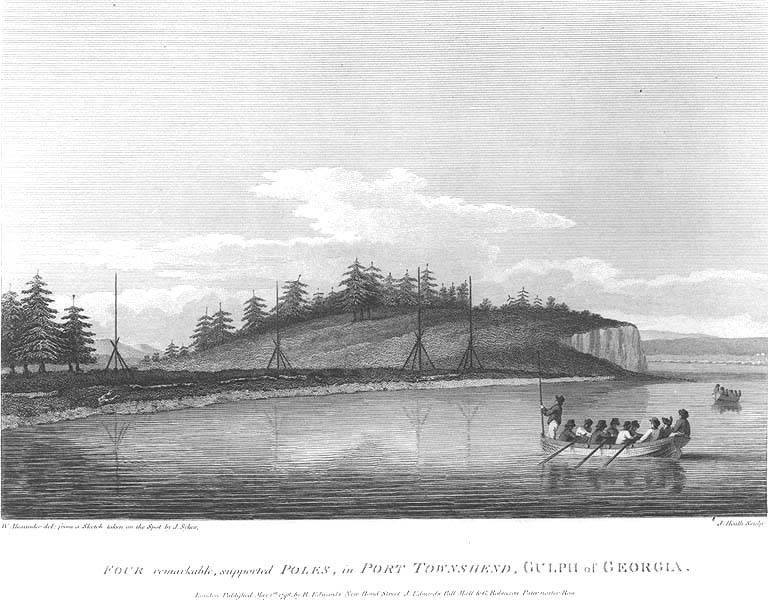
I tend to get some mileage from images and text from George Vancouver's journal concerning some enigmatic poles. Vancouver died failing to comprehend their purpose, and I reveal the findings of ethnography only after considerable effort on the part of the students to comprehend their purpose from Vancouver's descriptions.
In the past, I have presented an extract from the pen of Captain James Cook as a photocopy with the title "hostilities expected":
Even the name Nootka stems from misunderstanding. A separate handout has this passage alongside another from the same source. I label them "Nuu-chah-nulth orature".
Tonight, students are receiving as photocopies the chapter in Cook's A Voyage to the Pacific Ocean (1784) from which this passage is extracted. They are also receiving the Sound Heritage article "The Contact Period as Recorded by Indian Oral Traditions," edited by Barbara S. Erfrat and W.J. Langlois that was Ruth Kirk's source for the brief extracts in her book.
When we meet for the second time, Wednesday, I will expect that they have read these twenty-five pages and written half a dozen questions that require research to answer.
My plan tonight is to start with the questions:
1. What is history?
2. Why does history merit our attention?
3. What are the boundaries of the Pacific Northwest?
All of these questions are addressed to an extent in my PowerPoint presentations, which we may or may not get to.
I teach adult students--minimum age is 25--in six week classes that usually meet twice per week for 3 1/2 hours (there's an option of once per week and two eight-hour Saturdays). I lecture too much in these classes. The lectures give me a sore throat, and are grueling endurance tests for the students, but they also stimulate innovative uses of PowerPoint.
A new class begins tonight: Pacific Northwest History. My usual first week lectures include a 42 slide presentation ("Inventing a Hinterland") and another 60 slide presentation ("Historiography and Colonization"). Both presentations offer up some gems, but can be deadly if I fail to engage the students in thinking historically.

I tend to get some mileage from images and text from George Vancouver's journal concerning some enigmatic poles. Vancouver died failing to comprehend their purpose, and I reveal the findings of ethnography only after considerable effort on the part of the students to comprehend their purpose from Vancouver's descriptions.
In the past, I have presented an extract from the pen of Captain James Cook as a photocopy with the title "hostilities expected":
During these visits they gave us no other trouble than to guard against their thievish tricks. In the morning of the 4th we had a serious alarm. Our party on shore, who were employed in cutting wood and getting water, observed that the natives all around them were arming themselves in the best manner they could, those who were not possessed of proper weapons preparing sticks and collecting stones. On hearing this I thought it prudent to arm also, but, being determined to act upon the defensive, I ordered our workmen to retreat to the rock upon which we had placed our observatories, leaving the natives in quiet possession of the ground. Our fears were ill- grounded. These hostile preparations were not directed against us, but against a body of their own countrymen, who were coming to fight them; and our friends of the sound, on observing our apprehensions, used their best endeavors to convince us that this was the case. We could see that they had people looking out on each point of the cove, and canoes frequently passed between them and the main body assembled near the ships. At length the adverse party, in about a dozen large canoes, appeared off the south point of the cove, when they stopped, and lay drawn up in a line of battle, a negotiation having commenced. Some people in canoes, in conducting the treaty, passed between the two parties, and there was some speaking on both sides. At length the difference, whatever it was, seemed to be compromised, but the strangers were not allowed to come alongside the ships, not to have any trade or intercourse with us. (Italics added)It is a remarkable passage that should provoke a number of useful questions. I like to highlight the potential for miscommunication and misunderstanding. The novelty of Northwest Coast social and economic conventions, not yet understood by Cook and his crew (and probably not much understood at the end of their month in Nootka Sound) become evident in the expectations of attack when their "friends" are arming themselves against "strangers". Yet, Cook almost seems to comprehend that control of international trade was a central motivation for the threat of hostilities.
James Cook, Captain Cook’s Voyages Round the World (1897), 427
Even the name Nootka stems from misunderstanding. A separate handout has this passage alongside another from the same source. I label them "Nuu-chah-nulth orature".
So, the Chief told them to go out there again and see, you know. … They started making signs and they were talking and they were saying, ‘Nu-tka-icum.’ ‘Nu-tka- icum,’ they were saying. That means, ‘You go around the harbour [to find better anchorage].’ So Captain Cook said, ‘Oh. They’re telling us the name of this place is Nootka.’ That’s how Nootka got its name.I generally try to get the students to frame some historical questions stemming from these passages. In place of their own questions, they usually leave with some of my generalizations about mutually beneficial trade and the failures on intercultural communication.
… But the Indian name is altogether different. …
We call white people ‘Muh-mul-ni’ because … they came in boats that looked high and strange to us, and muh-mul- ni means ‘houses on the water.’ Those people seemed to be in houses floating on the water.”
Mrs. Winnifred David, Sound Heritage, vol. 7 (1978); quoted in Ruth Kirk, Tradition and Change on the Northwest Coast (1986), 201
Tonight, students are receiving as photocopies the chapter in Cook's A Voyage to the Pacific Ocean (1784) from which this passage is extracted. They are also receiving the Sound Heritage article "The Contact Period as Recorded by Indian Oral Traditions," edited by Barbara S. Erfrat and W.J. Langlois that was Ruth Kirk's source for the brief extracts in her book.
When we meet for the second time, Wednesday, I will expect that they have read these twenty-five pages and written half a dozen questions that require research to answer.
My plan tonight is to start with the questions:
1. What is history?
2. Why does history merit our attention?
3. What are the boundaries of the Pacific Northwest?
All of these questions are addressed to an extent in my PowerPoint presentations, which we may or may not get to.
07 September 2009
Benefits of History
You’ll need the insights and critical thinking skills you gain in history and social studies to fight poverty and homelessness, crime and discrimination, and make our nation more fair and more free.
Prepared Remarks of President Barack Obama Back to School Event, 2009
How does history teach critical thinking skills?
20 August 2009
Washington, Adams, Jesus
Jesus is benevolence personified, an example for all men.How significant was Christianity to the American Revolution? To the Constitutional Convention, and to the Constitution? How significant were Christianity and Biblical precepts to the practice of government by members of the revolutionary generation?
John Adams
These questions concerning the influence of Jesus Christ in America derive from broader questions.
What principles of philosophy were central to the ideas of government embraced by the men that wrote the Declaration of Independence and the Constitution of the United States, and that governed the the incipient nation that emerged? Who influenced the Founders, as we have come to call this group of men? How did they derive our system of government from their influences?
Entire careers are built on these historical questions. Historians pursue answers; politicians embrace or denounce their interpretations; pundits proclaim their conclusions.
A Patriot's History of the United States (2004) by Larry Schweikart and Michael Allen offers:
Many of his biographers trumpeted Washington's faith, and a famous painting captures the colonial general praying in a snowy wood, but if Washington had any personal belief in Jesus Christ, he kept it well hidden. Like Franklin, Washington tended toward Deism, a general belief in a detached and impersonal God who plays no role in human affairs.Washington's successor as President brought a different faith into the Executive office (our standard metonymy, the White House, becomes available for the first time in the administration of Thomas Jefferson).
Schweikart and Allen, 130
A brilliant attorney, patriot organizer, and Revolutionary diplomat, Adams exuded all the doctrinal religion missing in Washington, to the point of being pious to a fault. ... Adams brought a sense of the sacred to government that Washington lacked, placing before the nation an unwavering moral compass that refused compromise.There is a tendency to use labels among some who inquire into the faith of the men that wrote our founding documents and that served in the government thus established. John Adams was a Christian, and a Calvinist at that. Benjamin Franklin was a Deist. Thomas Jefferson was a Theist, or perhaps an Atheist, according to Abigail Adams and others who wish to embrace, condemn, or mourn his philosophy. These labels become points of contention; questioning their accuracy foments debate that drives scholars back into the archive, their place of refuge.
Schweikart and Allen, 131
These labels illuminate and obfuscate. They might shed light on the beliefs of a man or woman. Although John Adams may have wavered in his faith during his later years, his wife Abigail remained devout. There is no question that James Madison considered a career in the ministry. That his family was Episcopal,* but sent him to a Presbyterian college is easily established. The influence of John Calvin's idea of total depravity upon Madison's concepts of government is less clear and open to debate.
John Adams was the child of New England Puritanism. He was "pious to a fault," Schweikart and Allen explain. His devout faith or his abrasive personality isolated him among his peers at the Second Continental Congress. The Declaration of Independence was his idea, but it would have been rejected if he proposed it. Some delegates voted against whatever Adams put forth. In order to circumvent this animosity, Adams worked behind the scenes, prompting other men to put forth his ideas as if they were their own.
Some historians consider John Adams the worst President in U.S. history, surpassed in infamy only by George W. Bush (stay with me conservative readers, please--assessments of Bush are not yet history). Schweikart and Allen, although they do not shrink from assessing his failures, credit him with "establishing the presidency as a moral, as well as a political, position" (131). Richard Nixon was a crook; Jimmy Carter was a morally grounded incompetent; George W. Bush was born again; William Jefferson Clinton was a morally bankrupt philanderer. All these assertions, whether accurate or not, stand on the foundation of John Adams' moral leadership, upon the rock of his faith.
Researching Patriots
When I read A Patriots History of the United States, or most any other book for that matter, I tease the text with a set of mundane questions concerning scholarship.
How accurate are the contentions? What supporting evidence is presented? Do they accurately represent the views of those they cite? Do they quote accurately? Out of context? Who agrees with them? Who disagrees? How does this contention compare to assertions of other historians? Where does their ideology illuminate their subject? Where does it obscure?
What did John Adams have to say for himself? What did he say about his religious faith, about God, about Jesus?
The Online Library of Liberty has digitized and rendered searchable the ten volume The Works of John Adams, Second President of the United States: with a Life of the Author (1856), edited by Charles Francis Adams. This text seems a good enough place to begin, so I entered God into the search box only to learn that search terms must have at least four letters. Jesus was more productive. The name of Jesus appears twenty-eight times in these ten volumes.
The scattered references to Jesus across Adams' writing vary in their focus, but appear in the author's autobiography, as well as his letters. There is one instance in a critically important text for considering his philosophy of government in the years leading up to the Revolution: "A Dissertation on the Canon and Feudal Law" (1865). Of those that settled America, and their resistance to residual feudalism, Adams offered:
They knew that government was a plain, simple, intelligible thing, founded in nature and reason, and quite comprehensible by common sense. They detested all the base services and servile dependencies of the feudal system. They knew that no such unworthy dependencies took place in the ancient seats of liberty, the republics of Greece and Rome; and they thought all such slavish subordinations were equally inconsistent with the constitution of human nature and that religious liberty with which Jesus had made them free.This passage does not speak to Adams' personal faith, but it demonstrates part of his understanding of the faith of his forebears.
The Works of John Adams, vol 3, 454
We learn more of a personal nature from a batch of letters to several friends, including Thomas Jefferson. During the winter 1816-1817 Adams' reading included Origine de tous les Cultes, ou la Réligion Universelle (The Origin of All Worships) by Charles François Dupuis, published in twelve volumes in 1795 and in an abridged version in 1798. Adams, if I read his letters correctly, first read the twelve volumes, then borrowed Jefferson's copy of the abridgment and read that.
Dupuis rejected the notion of revelation, even comparing Jesus to a ghost.
We shall therefore not investigate, whether the Christian religion is a revealed religion. None but dunces will believe in revealed ideas and in ghosts. The philosophy of our days has made too much progress, in order to be obliged to enter into a dissertation on the communications of the Deity with man, excepting those, which are made by the light of reason and by the contemplation of Nature.Adams did not agree with Dupuis, but confessed that he lacked the time or knowledge of the world's mythologies to write the necessary rejoinder. He did consider Dupuis more stimulating than his other reading that winter. He told Jefferson that Dupuis offered more novelty.
Charles François Dupuis, The Origin of All Religious Worship (1872 [1798]), 216
I must acknowledge, however, that I have found in Dupuis more ideas that were new to me, than in all the others. My conclusion from all of them is universal toleration. Is there any work extant so well calculated to discredit corruptions and impostures in religion as Dupuis?The lessons he derives include both the need for purification of Christianity and tolerance of beliefs. Dupuis does not persuade him of his thesis that Christianity derives from ancient worship of the sun, but the text provokes inquiry into "superstition and fraud" that weave themselves into Christian faith. Adams letter two days after Christmas 1816 to Francis Adrian van der Kemp sums up the major themes, and provides the text for my epigraph above.
Adams to Jefferson, 12 December 1816
Jesus is benevolence personified, an example for all men. Dupuis has made no alteration in my opinions of the Christian religion, in its primitive purity and simplicity, which I have entertained for more than sixty years. It is the religion of reason, equity, and love; it is the religion of the head and of the heart. ...Searching for Jesus in the writings of John Adams does not fully answer the question, but it provides a framework for inquisitive reading.
How could that nation preserve its creed among the monstrous theologies of all the other nations of the earth? Revelation, you will say, and especial Providence; and I will not contradict you, for I cannot say with Dupuis that a revelation is impossible or improbable.
Christianity, you will say, was a fresh revelation. I will not deny this. As I understand the Christian religion, it was, and is, a revelation. But how has it happened that millions of fables, tales, legends, have been blended with both Jewish and Christian revelation that have made them the most bloody religion that ever existed? How has it happened that all the fine arts, architecture, painting, sculpture, statuary, music, poetry, and oratory, have been prostituted, from the creation of the world, to the sordid and detestable purposes of superstition and fraud?
John Adams to F. A. Vanderkemp, 27 December 1816
*This word is employed in John Eidsmoe, Christianity and the Constitution: The Faith of Our Founding Fathers (1987), 94 ff. However, for the time leading up to the Revolution, the Episcopal Church in America remained Anglican. The creation of the Episcopal denomination is part of the process of separation from England. In the context above, the word Episcopal strikes me as anachronistic. On the other hand, calling Madison Anglican might connote questions concerning his patriotism. See "Calvin and the Constitution" for more concerning Eidsmoe's views of Madison, and some links concerning Calvin's influence.
Addendum:
Jonathan Rowe also quotes from Adams letter to F.A. van der Kemp in a post for American Creation that is cross-posted on his own blog.
13 August 2009
Reflective Thinking, Teaching and Learning
"Am I a professor? Then what will I say today? But if I am a teacher, what will they do today?"The New Social Studies of the 1960s aimed to transform classrooms that had been conduits for the transmission of knowledge into agents of cultural change. Looking back from the standpoint of 1992, Byron Massialas summarized the prospects of teaching through inquiry.
Lendol Calder, 1370
Through a proper classroom environment and teaching method, students of virtually any age could be involved in reflection and critical thinking. Springboards from any of the traditional social sciences and history could be introduced into the classroom to create interest and reflective thinking about social events.His use of springboard as metaphor for the value of history, sociology, geography, economics, and other disciplines all serving something higher called Social Studies merits more examination than I can give it here.
Massialas, "Retrospect and Prospect," 121
Although the reform movement began with consideration of social-political contexts and psychological factors affecting students, Massialas tells us, many teachers embracing this reform movement emphasized "the structure of knowledge of the organized disciplines" (121). Historians, for example, failed to see that their disciplinary knowledge and processes were means to another end, a place to start but not the map. History dominated the curriculum that Massialas and his associates sought to transform into Social Studies. They conducted empirical studies of classroom practices that "confirmed the idea that a social-issues, rather than a traditionally chronological, curriculum is more in tune with the demands of modern society" (122).
The New Social Studies Movement ended by the mid-1970s; that is, it ended before I took a course in Social Studies teaching methods from a historian.
Undergraduate Education
O. Gene Clanton espoused some of the ideals of this now defunct reform movement. He advocated inquiry-based teaching of history in his methods class as theory, and his practice seemed to reflect this theory. Clanton had been my professor two years earlier for the second half of the American history survey: U.S. History, 1877 to present. In that class, he structured our classroom practices around what he called an inquiry approach. He divided the class of sixty or so into two groups; his teaching assistant took the other half. We then sat in a circle and talked about the documents--primary sources, mostly texts--that followed each narrative chapter in Richard N. Current, American History: A Survey, vol 2.
Clanton's teaching of history was refreshing and liberating. But it was not the method of inquiry-based reflective thinking and learning espoused by Massialas and his colleagues. Clanton did most of the talking.
In Inquiry in Social Studies (1966), Massialas and C. Benjamin Cox make the point that a discussion technique does not necessarily alter the method of classroom as conduit.
[T]he teacher assumes the role of expositor of knowledge while his students act as recipients. The materials at hand are the sources of knowledge and the major task involved is most easily described as the process of transmitting finished knowledge from source to recipient. The techniques utilized in this transmission, whether lecture, discussion, student reporting, or film projection do not differentiate the method itself. If the intent is to inform students of some already organized system of predetermined knowledge, the method is expository.Paulo Friere calls this expository method the banking concept of education. The teacher (subject) narrates to passive receptacles or listening objects (students).
Massialas and Cox, 62
Education thus becomes an act of depositing, in which the students are the depositories and the teacher is the depositor. Instead of communicating, the teacher issues communiques and makes deposits which the students patiently receive, memorize, and repeat.The alternative sought through the New Social Studies was concept based, student centered, and focused on contemporary problems. The teacher was to manage and coordinate, rather than dispense, the construction of knowledge. In my education courses, the professors used the term facilitate.
Friere, 53
The materials at hand are at once the sources of promising springboards or hypotheses and the compilations of factual evidence required to support or refute these hypotheses. The students in this case become participants in the process of reorganizing this knowledge around new centers of attention and interest. The learning situation is characterized by the seeking, discovering, reorganizing, and testing of knowledge.This movement towards inquiry based teaching in social studies ran aground. When I was in college, several history professors dismissed it as a fad of the Sixties. Even so, to the extent that it was part of other educational developments that favored student centered education, it echoes through much of educational theory today, if not the practice of teaching. It should come as no surprise, therefore, that prescriptions for developing reflective thinking in high school and middle school social studies classrooms anticipate recent calls for rethinking the history survey in college classrooms.
Massialas and Cox, 62
Teaching and Learning
Checking e-mail in class is rude and immature, but it is also a predictable response to a worn-out pedagogy that no longer has a place in the history survey.In his essay, "Uncoverage: Toward a Signature Pedagogy for the History Survey," Lendol Calder seeks ways to empower students as the agents of their own learning. He refers to a label Sam Wineburg used in conversation with him: the attic theory. Wineburg's attic theory of cognition resembles Friere's banking concept, or what Massilas and Cox call expository teaching.
Lendol Calder, 1360
As it happens, people do not collect facts the way homeowners collect furniture, storing pieces for use at a later time. ... Facts are not like furniture at all; they are more like dry ice, disappearing at room temperature.Calder points out that covering a subject means not only going the length, but also connotes concealment. Historians, he alleges are quite adept at covering up, or "hiding what it means to be good at history" (1363). Like Wineburg in his book Historical Thinking and Other Unnatural Acts (2001), Calder attempts to identify the peculiar signature of the practice of history. He seeks to introduce to his students six "cognitive habits: questioning, connecting, sourcing, making inferences, considering alternate perspectives, and recognizing limits to one's knowledge" (1364).
Calder, 1361
Calder's process in his course on American history since 1945 is particularly relevant to Patriots and Peoples (this blog). His course divides into six units; each goes through a three stage process. Film clips are used
to create an environment so rich in information and so charged with interesting problems that students who are inert in the face of lectures and textbooks will be stirred to ask a few historical questions. After the film awakens their capacity for wonder, I then send students out to do what historically minded people do: follow a question that takes them beyond what they already know.In the second stage, the class examines primary documents. Entry to class requires a ticket: a three to five page essay on questions formulated by the student (inspired by the film), and using the documents as evidence. One gets the sense that Calder is looking for questions that are focused on the time and place of the United States in the past half-century or so, rather than broad universal questions of the sort favored by the New Social Studies reformers.
Calder, 1364
A generalization, in order to have wide applicability, must not refer to a specific event, period, or region. A more reliable and useful generalization would be one which, if formulated as a theory, can apply to all times and places.After formulating their own questions, and answering them through analysis of prescribed documents, the students are prepared to read the work of professional historians. Calder uses Howard Zinn, A People's History of the United States and Paul Johnson, A History of the American People. Johnson's work is stronger, that is, less polemical than Schweikart and Allen's A Patriot's History of the United States.
Massialas and Cox, 333
Theorie und Praxis
As a student in high school and college, I craved the rare opportunities to talk back, to argue with the professor, and to get expert guidance in my own self-directed study of the past and its relevance to the present. On the other hand, I would have felt cheated in a course concerned with the late-nineteenth century if the author of Kansas Populism: Ideas and Men (1969) and Populism: The Humane Preference in America, 1890-1900 (1991) should have considered it his place to be silent while my peers and I constructed our knowledge from William Jennings Bryan's Cross of Gold speech. It was good that the doctor in class was a teacher, but he needed to be a professor, too.
As a teacher, I remember that Clanton's practice did not quite match his theory. Nor does my own practice of PowerPoint based presentations interspersed with focused discussion quite match my theory tersely expressed in the title of Carl Becker's classic article, "Everyman His Own Historian." I follow Clanton in looking for balance between making useful deposits and facilitating student management of their investments.
Works Cited
Becker, Carl. "Everyman His Own Historian." American Historical Review (January 1932): 221-236.
Calder, Lendol. "Uncoverage: Toward a Signature Pedagogy for the History Survey." The Journal of American History (March 2006): 1358-1370.
Clanton, O. Gene. Kansas Populism: Ideas and Men. Lawrence: University Press of Kansas, 1969.
________. Populism: The Humane Preference in America, 1890-1900. Boston: Twayne Publishers, 1991.
Friere, Paulo. Pedagogy of the Oppressed, trans by Myra Bergman Ramos. New York: Continum, 1993.
Johnson, Paul. A History of the American People. New York: HarperPerennial, 1998.
Massialas, Byron G. "The 'New Social Studies'--Retrospect and Prospect." The Social Studies (May/June 1992): 120-124.
Massialas, Byron G., and C. Benjamin Cox. Inquiry in Social Studies. New York: McGraw-Hill, 1966.
Schweikart, Larry, and Michael Allen. A Patriot's History of the United States: From Columbus's Great Discovery to the War on Terror. New York: Sentinel, 2004.
Wineburg, Sam. Historical Thinking and Other Unnatural Acts: Charting the Future of Teaching the Past. Philadelphia: Temple University Press, 2001.
Zinn, Howard. A People's History of the United States, 1492 - Present. New York: HarperCollins, 1980.

Subscribe to:
Posts (Atom)