


By the time of the Civil War, there were more than 80 varieties of grapes growing in the Walla Walla Valley. Italian immigrant Frank Orselli was selling wine by 1865. In 1876, the Walla Walla Statesman reported that he "has been experimenting in making wine" (Irvine and Clore, 406).
During Prohibition it was legal for a head of household to make 200 gallons of wine per year for personal use. A few commercial winemakers, especially in California, managed to limp along during these dark years making communion wine for the Catholic Church. Two years after the repeal of Prohibition, the Washington Wine Producers Association was established.
In 1960, Walter Clore and associates began grape growing research for Washington State University. This publicly funded research joined forces with private enterprise over the next several decades to develop the largest North American wine industry outside of California. Today, Columbia Valley wines are world renowned and the Walla Walla Valley bustles with tourists during the summer months. They come along the Lewis and Clark Trail, and via other routes, to visit the missionary graves at the Whitman Mission, and they come to sample and buy Washington wines.
My Wine Journey
Like the Whitmans, I spent a couple of years as a teetotaler in the 1980s. Fortunately, that period had come to an end by the time that I attended my first academic conference as a graduate student, the 1989 Pacific Northwest American Studies Association annual conference. It was held at Whitman College, and the Saturday evening banquet began with a bus ride west to Lowden (formerly known as Frenchtown). We had hors d'oeuvres, wine, and dinner at L'Ecole No. 41 winery, Walla Walla's third winery in the modern era. They were just beginning to garner accolades from the international community. I'm fuzzy on some aspects of my personal history, but I might credit the wine I had that evening for the fact that for the better part of the next decade, choosing wine instead of beer or bourbon invariably meant that I would choose a Merlot from Washington state.
I have not had a glass of bourbon since May, and I've drank very little beer. Credit wine. The past few years I've been developing the beginning of some interest in wine, and beginning to educate my palate. Perhaps four years ago, my wife and I sat down with Kevin Zraly, Windows on the World: Complete Wine Course (2007), reading and drinking our way through a glass each of Riesling, Sauvignon Blanc, and Chardonnay. The past few months, I've been rediscovering the wines grown in my home state. I'm learning to pair some of these wines with food. Yesterday, we tasted some wine at the Spokane Public Market and came home with some Bridge Press Cellars Pinot Blanc--a Spokane wine made from Willamette Valley, Oregon grapes.
I'll return to wine history in a future blog post. For now, take a look at this gallery of meals and some of my own recipes.
Food and Wine Gallery
I learned to cook from my mother when I was quite young, and also learned some cooking in the Boy Scouts. In 1975, over a campfire I cooked two dozen eggs over easy without breaking one. In the past two years, I've been learning new cooking methods from Food & Wine Magazine. Recently I started photographing some of my meals and posting the images to Facebook. Many of the recipes come from the magazine. I was surprised, thus, to discover that my pairings with Washington wines rarely featured recipes from this magazine, but from other magazines and cookbooks, and mostly my own inventions. Even so, the influence of Food & Wine is evident in many details.
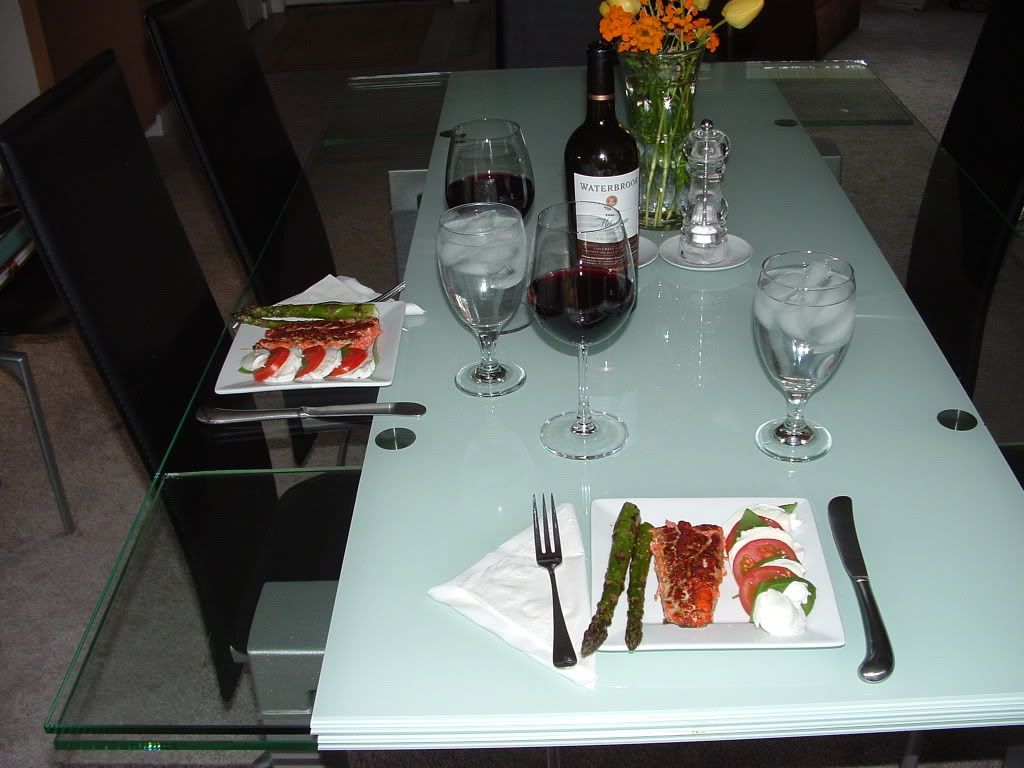 In late spring or early summer most years, fresh Copper River salmon becomes available in Spokane grocery stores. I usually buy one fish and get four or five meals--some steaks, some fillets. This year, as the price kept dropping due to an abundant catch, I bought three fish. I butterflied the second one and smoked it on my gas grill. It was topped with a rub of herbs and spices, but I failed to record the mixture. The salad is an old standard of fresh basil from the garden, tomatoes, and mozzarella cheese. I snapped the photo before drizzling the balsamic vinegar. A few spears of asparagus were grilled over the flame on one side of the grill as the salmon finished. These were first sprayed with olive oil and lightly sprinkled with salt and pepper. The wine was a 2008 Waterbrook Melange Noir (less than $15).
Waterbrook Winery was founded in 1984 as Walla Walla's fourth modern winery. When my spouse, my sister and her spouse, my nephew and his girlfriend, and I made our recent pilgrimage to Walla Walla for wine tastings, we began with a wonderful hour on the patio at Waterbrook. This meal with Alaska Sockeye and Washington wine was one month prior to that trip.
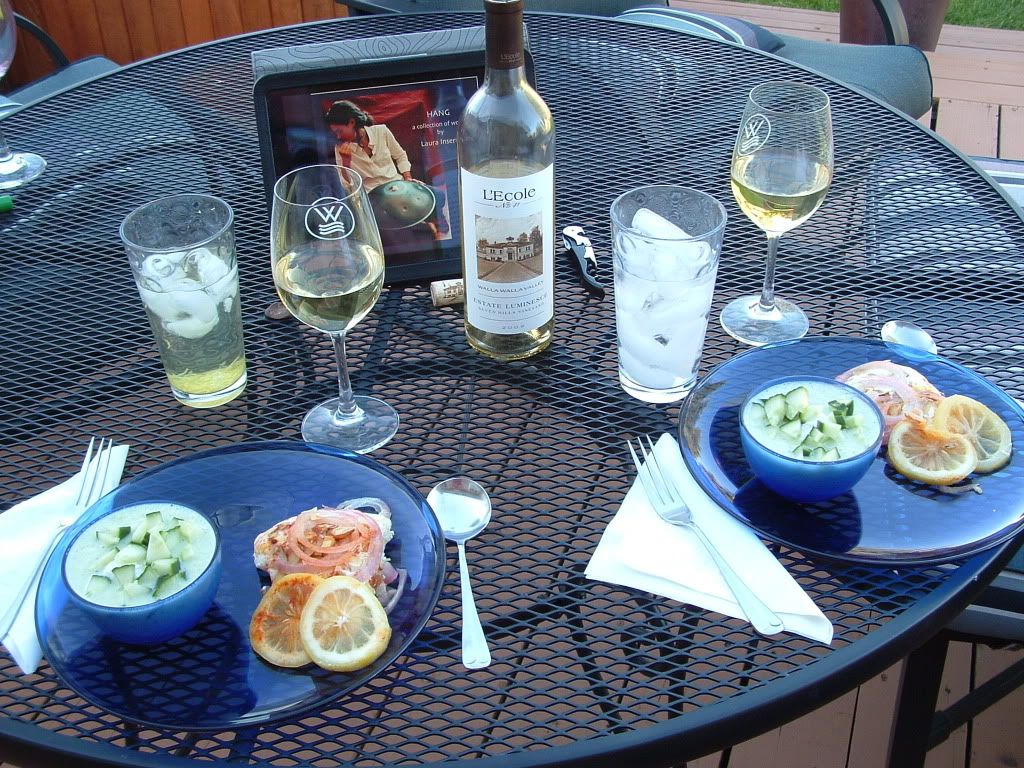 Our second winery on that trip was L'Ecole No. 41, where I had eaten dinner in 1989. My trip there with a bunch of college English and history teachers is the earliest memory that I have of eating dolmades. Since then, I have learned to make them, and they were hors d'oeuvres for the anniversary dinner that I prepared for my wife last month.
Naturally, we tasted and purchased some Merlot when we visited L'Ecole No. 41. We did not start with the Merlot. Prior to the trip, I had been reading Paul Gregutt, Washington Wines and Wineries: The Essential Guide (2007). He praises the success of L'Ecole's Semillon, and we began with that. My wife generally refuses to get interested in any wine that we can see through, but she liked the Semillon. She found the Estate Luminesce exciting! We returned with a couple of bottles of each. When she found some enticing summer recipes in an article in More magazine the following week, I had the beginning of a fine pairing. I made the cold cucumber and honeydew soup from "Picnics for Grownups," pulled an old walleye recipe from America's Favorite Fish Recipes (1992) for some Alaskan cod, and served one of the bottles of Luminesce.
When I started reading Food & Wine, they seemed obsessed with flatiron steak, and I've made a couple of their recipes. After the Fourth of July weekend included some heavy eating with family, we were in the mood for some salads. I made a simple green salad with my own something like Caesar dressing on Tuesday, followed it up with the cucumber soup and cod above on Wednesday, and on Thursday used some of Tuesday's dressing to marinade asparagus and broccoli.
 Something Like Caesar
1 Tbs grated Parmigiano-Reggiano
olive oil (about 4 Tbs)
2 anchovies finely chopped
2 cloves garlic minced
1 Tbs Dijon Mustard
1 Tbs Worcester Sauce
salt and pepper
I put the cheese in the bottom of my salad bowl and cover it with olive oil. Then add the anchovies, garlic, mustard and Worcester Sauce and stir, adding more olive oil until the consistency seems about like bottled Caesar. A little bit of salt and a little more pepper, more stirring, and the dressing is done.
The quantity is too much for one salad feeding two or three people, so I spoon about two-third's of the dressing into a container that goes into the refrigerator. Leaving the portion that I plan to use, I then put my greens on top of the dressing and gently stir. Putting the greens on the dressing and mixing instead of the dressing on the greens is a technique that I've adopted from several recipes in Food & Wine, and from "Chef Bobby Flay's Salad Smarts," a sidebar in Food & Wine Annual Cookbook 2011 (42).
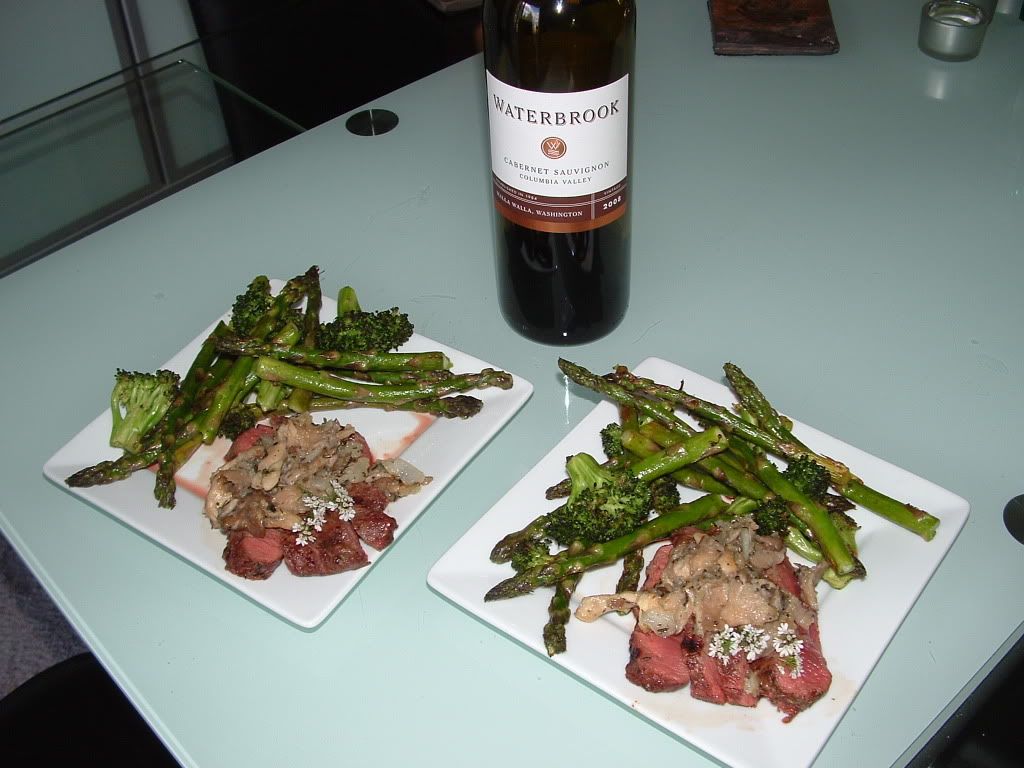
In preparing the asparagus and broccoli dish in the photo, I first retrieved the dressing from the refrigerator and let it come up to room temperature. Then, I prepared the steak marinade by putting a diced onion, rosemary, and sage in the Magic Bullet to mostly liquify. I spread the mixture on the steak and let it sit for an hour or so. I washed the asparagus, breaking off the thickest part of the stems, and washed the broccoli. In a plastic bag, I spooned some of the leftover dressing on the vegetables, closed the bag with plenty of air inside and shook to coat. I let the vegetables sit on the counter for most of an hour.
When it was time to cook, I scraped the onion mixture off the steak. I grilled the vegetables in a grilling basket. When they were nearly done, I started grilling the steak (about four minutes per side). Meanwhile, I sauteed the onions in some olive oil with fresh oyster mushrooms. After removing the steak from the grill, I sliced it, placed four slices on each plate and topped with the mushroom and onion mixture, then plucked a couple of cilantro flowers and set these on top.
The steaks and vegetable mix were served with a bottle of 2008 Waterbrook Cabernet Sauvignon.
At the Spokane Public Market,
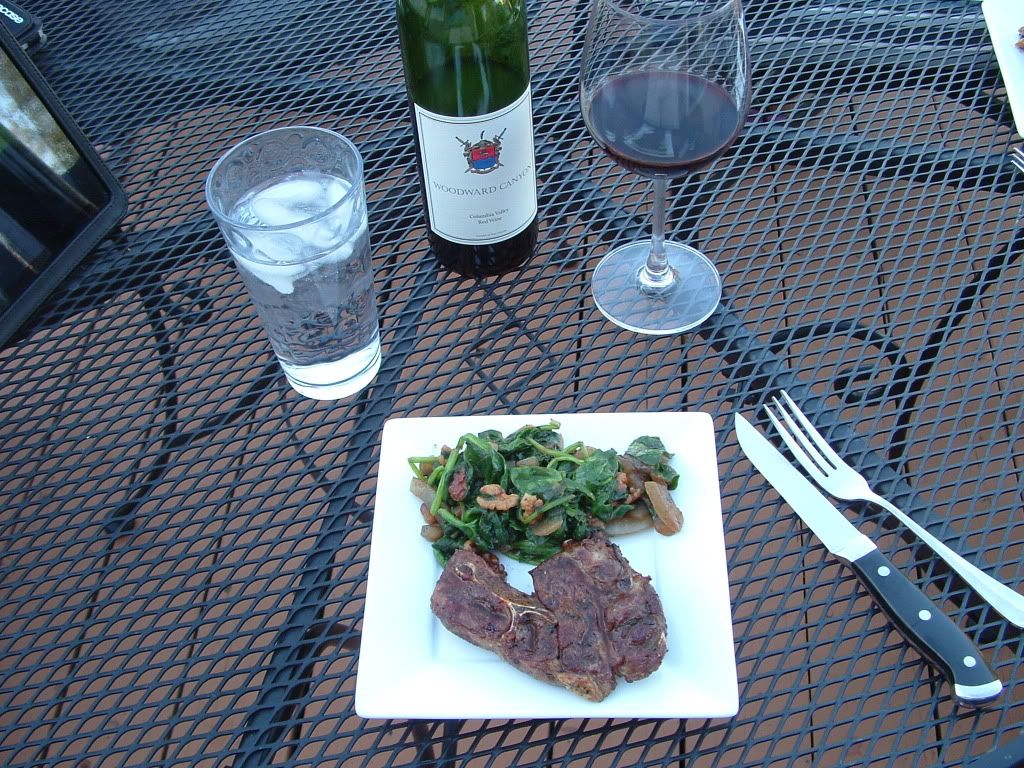 yesterday, we found some fresh Walla Walla sweet onions, and some lamb steaks from a local farmer. I mixed some dried mint with smaller amounts of cumin, and thyme, sprinkled it on the lamb steaks, and let set an hour.
I quartered half an onion, then sliced it. I sauteed the onion in olive oil until it started to brown, then added one-half cup Moscato wine and cooked until the wine evaporated. Then I added a handful of walnuts that I had roasted in the oven for eight minutes at 350 F.
While the onions and walnuts continued to brown on medium heat, I started the steaks, grilling seven or eight minutes per side. I poured a little white wine vinegar into the pan with the onions and nuts, and cooked until it evaporated. During the last two minutes of cooking the steaks, I threw about three cups of baby spinach leaves into the pan with the onions--stirring constantly until thoroughly wilted.
The lamb and spinach were served with a bottle of Woodward Canyon non-vintage red. The bottle had been opened earlier for the hors d'oeuvres, plank grilled figs with pancetta and goat cheese, a recipe from Epicurious.com. Woodward Canyon was Walla Walla's second modern winery, and it was the third we visited during our pilgrimage. Their non-vintage red was the discovery of the trip--an extremely nice wine for $19 per bottle.
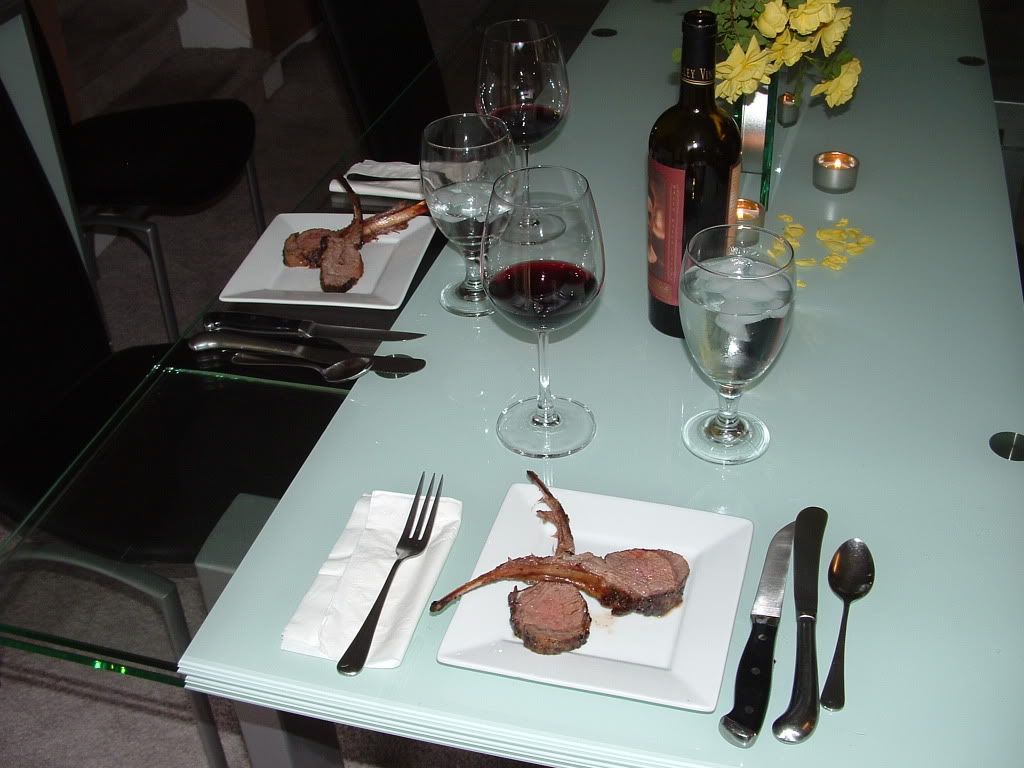 Our wine budget accommodates very few wines above $20 per bottle, and generally only on special occasions. During a trip to Walla Walla this spring for a work conference, my wife picked up a couple of Spring Valley Vineyard wines that are expensive by our standards. We opened a bottle of 2007 Frederick for our anniversary. I fixed a four-course meal for the occasion. It was a study in pairings.
The first course consisted of dolmades (my recipe) and goat cheese stuffed grape leaves from Food & Wine. To be honest, the $50 bottle of Frederick did not seem particularly impressive with the hors d'oeuvres. It was good, but not great.
The second course was a beet, pickled cheery, and crispy shallot salad from Food & Wine. It clashed with the wine, bringing out bitter flavors.
For the main course, I grilled a Turkish rack of lamb from Jamie Purviance, Weber's Time to Grill (2011). Together with Frederick, the lamb was exquisite and the wine showed its grace and complexity. It was a perfect pairing. After the main course, we were satiated and delayed dessert for a few hours.
Dessert was another Food & Wine recipe, except that I added some goat cheese and nuts. We ate the dessert with a glass of the plum wine used to marinate the plums.

