Google
 
Showing posts with label Resources for History. Show all posts

13 December 2013

Atlantic History: Web Resources

Work in Progress

Instead of a European discovery of a new world, we might better consider it as a sudden and harsh encounter between two old worlds that transformed both and integrated them into a single New World.
D. W. Meinig, The Shaping of America: A Geographical Perspective on 500 Years of History (1988)
Atlantic history concerns four continents--Europe, Africa, North America, and South America--and the islands between from the fifteenth century to the end slavery in the Americas in the nineteenth century. Its principal theme concerns the movement of peoples, flora and fauna, and ideas. The Atlantic world shaped the foundations of the modern world.

National histories have proven inadequate for understanding such transnational phenomena as slavery, colonialism, disease, the economic expansion of Europe, and environmental transformation.

Oxford Bibiographies asserts the field is "determinedly polycentric rather than monocentric." That is, Europeans are not actors to whom colonized peoples react. Rather, the Atlantic World was one in which diverse peoples interacted in complex and ever-changing ways.

This post lists websites that have value to students and faculty in college courses in Atlantic History (a course that I will teach for the first time in fall 2014). It will be updated. Suggestions are particularly welcome.

General Sites

"Atlantic History," Oxford Bibliographieshttp://www.oxfordbibliographies.com/obo/page/atlantic-history.

H-Atlantic Discussion Group, http://www.h-net.org/~atlantic/index.html.

International Seminar on the History of the Atlantic World, 1500-1825, Harvard University, http://www.fas.harvard.edu/~atlantic/.

European Exploration

The European Voyages of Exploration, University of Calgary, http://www.ucalgary.ca/applied_history/tutor/eurvoya/index.html.

1492: An Ongoing Voyage, Library of Congress, http://www.ibiblio.org/expo/1492.exhibit/Intro.html.

Columbian Exchange

The Columbian Exchange, Gilder Lehrman Institute of American History, http://www.gilderlehrman.org/history-by-era/american-indians/essays/columbian-exchange.

Slavery

The Atlantic Slave Trade and Slave Life in the Americas: A Visual Record, Virginia Foundation for the Humanities and the University of Virginia, http://hitchcock.itc.virginia.edu/Slavery/index.php.

Trans-Atlantic Slave Trade database, Emory University et al., http://www.slavevoyages.org/tast/index.faces.

The African Slave Trade and the Middle Passage (part of Africans in America), PBS, http://www.pbs.org/wgbh/aia/part1/1narr4.html.

The Abolition Project, East of England Broadband Network, http://abolition.e2bn.org/index.php.

African History

African Journal of Criminology and Justice Studies, University of Maryland, Eastern Shore, http://www.umes.edu/ajcjs/default.aspx?id=148.

"I Speak of Africa," King's College, London. Online Exhibit, http://www.kingscollections.org/exhibitions/specialcollections/i-speak-of-africa/.

Kingdom of Ghana, African Studies Center, Boston University, http://www.bu.edu/africa/outreach/resources/k_o_ghana/.

The Ouidah Museum of History, Department of Cultural Patrimony, Benin, http://www.museeouidah.org/accueil.htm

Timbuktu: World Heritage Site, National Geographic, http://travel.nationalgeographic.com/travel/world-heritage/timbuktu/.

European History

Internet Modern History Sourcebook, Fordham University, http://www.fordham.edu/halsall/mod/modsbook.asp.

British History Online, Institute of Historical Research and History of Parliament Trust, http://www.british-history.ac.uk/Default.aspx.

North America

American Memory, Library of Congress, http://memory.loc.gov/ammem/browse/.

The Plymouth Colony Archive Project, http://www.histarch.illinois.edu/plymouth/index.html.

Latin America and Caribbean

Digital Library of the Caribbean, Florida International University, http://www.dloc.com/ufdc/.

Piracy

Piracy Trials, Library of Congress Law Library, http://www.loc.gov/law/help/piracy/piracy_trials.php.

"Sir Francis Drake: A Pictoral Biography by Hans P. Kraus," Rare Book & Special Collections Reading Room, Library of Congress, http://www.loc.gov/rr/rarebook/catalog/drake/drake-home.html.

Products

Sugar in the Atlantic World, University of Michigan, http://www.clements.umich.edu/exhibits/online/sugarexhibit/exhibits-caseonlinesugar.php.

09 November 2009

Thinking Historically with Adult Students

(This post began as a response to the first in a series concerning Sam Wineburg, Historical Thinking and Other Unnatural Acts (2001) on John Fea's blog: The Way of Improvement Leads Home, "Historical Thinking and Other Unnatural Acts--Part One.")


I teach adult students--minimum age is 25--in six week classes that usually meet twice per week for 3 1/2 hours (there's an option of once per week and two eight-hour Saturdays). I lecture too much in these classes. The lectures give me a sore throat, and are grueling endurance tests for the students, but they also stimulate innovative uses of PowerPoint.

A new class begins tonight: Pacific Northwest History. My usual first week lectures include a 42 slide presentation ("Inventing a Hinterland") and another 60 slide presentation ("Historiography and Colonization"). Both presentations offer up some gems, but can be deadly if I fail to engage the students in thinking historically.


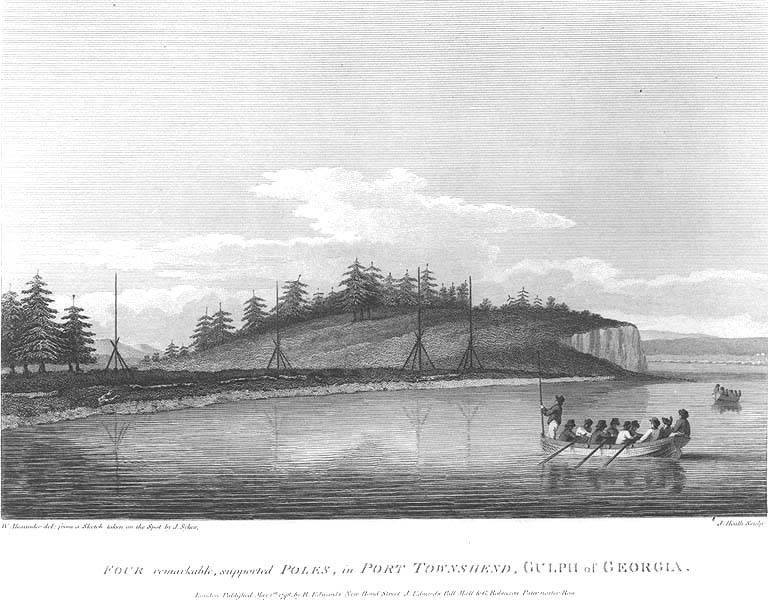
I tend to get some mileage from images and text from George Vancouver's journal concerning some enigmatic poles. Vancouver died failing to comprehend their purpose, and I reveal the findings of ethnography only after considerable effort on the part of the students to comprehend their purpose from Vancouver's descriptions.

In the past, I have presented an extract from the pen of Captain James Cook as a photocopy with the title "hostilities expected":

During these visits they gave us no other trouble than to guard against their thievish tricks. In the morning of the 4th we had a serious alarm. Our party on shore, who were employed in cutting wood and getting water, observed that the natives all around them were arming themselves in the best manner they could, those who were not possessed of proper weapons preparing sticks and collecting stones. On hearing this I thought it prudent to arm also, but, being determined to act upon the defensive, I ordered our workmen to retreat to the rock upon which we had placed our observatories, leaving the natives in quiet possession of the ground. Our fears were ill- grounded. These hostile preparations were not directed against us, but against a body of their own countrymen, who were coming to fight them; and our friends of the sound, on observing our apprehensions, used their best endeavors to convince us that this was the case. We could see that they had people looking out on each point of the cove, and canoes frequently passed between them and the main body assembled near the ships. At length the adverse party, in about a dozen large canoes, appeared off the south point of the cove, when they stopped, and lay drawn up in a line of battle, a negotiation having commenced. Some people in canoes, in conducting the treaty, passed between the two parties, and there was some speaking on both sides. At length the difference, whatever it was, seemed to be compromised, but the strangers were not allowed to come alongside the ships, not to have any trade or intercourse with us. (Italics added)
James Cook, Captain Cook’s Voyages Round the World (1897), 427
It is a remarkable passage that should provoke a number of useful questions. I like to highlight the potential for miscommunication and misunderstanding. The novelty of Northwest Coast social and economic conventions, not yet understood by Cook and his crew (and probably not much understood at the end of their month in Nootka Sound) become evident in the expectations of attack when their "friends" are arming themselves against "strangers". Yet, Cook almost seems to comprehend that control of international trade was a central motivation for the threat of hostilities.

Even the name Nootka stems from misunderstanding. A separate handout has this passage alongside another from the same source. I label them "Nuu-chah-nulth orature".
So, the Chief told them to go out there again and see, you know. … They started making signs and they were talking and they were saying, ‘Nu-tka-icum.’ ‘Nu-tka- icum,’ they were saying. That means, ‘You go around the harbour [to find better anchorage].’ So Captain Cook said, ‘Oh. They’re telling us the name of this place is Nootka.’ That’s how Nootka got its name.
… But the Indian name is altogether different. …
We call white people ‘Muh-mul-ni’ because … they came in boats that looked high and strange to us, and muh-mul- ni means ‘houses on the water.’ Those people seemed to be in houses floating on the water.”
Mrs. Winnifred David, Sound Heritage, vol. 7 (1978); quoted in Ruth Kirk, Tradition and Change on the Northwest Coast (1986), 201
I generally try to get the students to frame some historical questions stemming from these passages. In place of their own questions, they usually leave with some of my generalizations about mutually beneficial trade and the failures on intercultural communication.

Tonight, students are receiving as photocopies the chapter in Cook's A Voyage to the Pacific Ocean (1784) from which this passage is extracted. They are also receiving the Sound Heritage article "The Contact Period as Recorded by Indian Oral Traditions," edited by Barbara S. Erfrat and W.J. Langlois that was Ruth Kirk's source for the brief extracts in her book.

When we meet for the second time, Wednesday, I will expect that they have read these twenty-five pages and written half a dozen questions that require research to answer.

My plan tonight is to start with the questions:

1. What is history?
2. Why does history merit our attention?
3. What are the boundaries of the Pacific Northwest?

All of these questions are addressed to an extent in my PowerPoint presentations, which we may or may not get to.

05 May 2008

Meme Chain

Matthew K. Tabor said some kind words about Patriots and Peoples when he tagged me with this meme.

The rules:

  1. The rules of the game get posted at the beginning.
  2. Each player answers the questions about themselves.
  3. At the end of the post, the player then tags 5-6 people and posts their names, then goes to their blogs and leaves them a comment, letting them know they’ve been tagged and asking them to read your blog.
  4. Let the person who tagged you know when you’ve posted your answer.

Got it.

1) What was I doing 10 years ago?

Ten years ago I resumed fly fishing after having given it up in my youth. I knew, when I resumed fishing after graduate school, that bait chucking would lead to fly casting, and that casting a long rod would lead to fly tying. John Gierach puts it well: “Tying our own flies is where many of us go off the deep end with fly fishing. … I was sort of looking for the deep end” (Good Flies, 1). Ten years ago I sentenced myself to a life of obsessive idleness.

2) What are 5 things on my to-do list for today (not in any particular order):

  1. grade papers
  2. review lecture notes for evening class
  3. set-up meeting of executive team for 2009 Washington State Elementary Chess Championship
  4. work on preliminary budget for 2009 WSECC
  5. blog

3) Snacks I enjoy:

Italian salame, Dublin cheddar, Kentucky bourbon

4) Things I would do if I were a billionaire:

  1. Cast flies for trout in Patagonia
  2. Drink mojitos in Havana
  3. Play golf with Bill Gates

5) Three of my bad habits:

  1. speed chess
  2. watching television
  3. driving fast to get somewhere
  4. letting an occasional week go by without writing

6) 5 places I have lived:

  1. Baudette, Minnesota
  2. Klamath Falls, Oregon
  3. Clovis, New Mexico
  4. Moscow, Idaho
  5. Lenoir City, Tennessee

7) 5 jobs I have had:

  1. Pizza delivery driver, Dominos
  2. Convenience store clerk, graveyard shift
  3. Janitor, Northtown Mall
  4. Adjunct professor at alma mater
  5. Private chess tutor

8) 6 peeps I wanna know more about:

  1. Ed Darrell at Millard Fillmore’s Bathtub looks for truth (and finds errors) in history, science, and education.
  2. Ortho’s Baudrillard’s Bastard always offers something to think about.
  3. Miguel Antonio Guzmán does not appear focused upon Frank Zappa at Jazz from Hell.
  4. Historian Larry Cebula intimidates me with his content rich Northwest History. I’m using his Plateau Indians and the Quest for Spiritual Power as a text in my Pacific Northwest history course this summer.
  5. Historiann keeps readers engaged with issues affecting higher education, contemporary politics, and gender history.
  6. Brian Tubbs shares his passion for the American Revolution & Founding Era.

18 April 2008

Thomas Jefferson: Abolitionist?

In his Notes on the State of Virginia (1787), written during the American Revolution, Thomas Jefferson identified slavery as a "blot" and "moral evil" upon the nation's existence.
Under the mild treatment our slaves experience, and their wholesome, though coarse, food, this blot in our country increases as fast, or faster, than the whites. During the regal government, we had at one time obtained a law, which imposed such a duty on the importation of slaves, as amounted nearly to a prohibition, when one inconsiderate assembly, placed under a peculiarity of circumstance, repealed the law. This repeal met a joyful sanction from the then sovereign, and no devices, no expedients, which could ever after be attempted by subsequent assemblies, and they seldom met without attempting them, could succeed in getting the royal assent to a renewal of the duty. In the very first session held under the republican government, the assembly passed a law for the perpetual prohibition of the importation of slaves. This will in some measure stop the increase of this great political and moral evil, while the minds of our citizens may be ripening for a complete emancipation of human nature.
Jefferson, Notes on the State of Virginia, 87.
His belief that slaves were treated mildly in America would form part of the foundation of the defense of the Peculiar Institution. This passage does not sum all of Jefferson's views, but is one piece that cannot be ignored. His statement that ending slavery is part of "emancipation of human nature" lends credence to the view that he may have considered the assertion that "all men are created equal" in the Declaration of Independence to include African Americans.

An exchange between Conor Cruise O'Brien and Douglas L. Wilson in the Atlantic Monthly in 1996 offers one entry into the complexities of Jefferson's legacy. O'Brien draws from statements of Jefferson's a few chapters later in Notes on the State of Virginia, as well as other texts. Wilson challenges O'Brien's reading of some of these texts.


My copy of the text is William Peden, ed., Notes on the State of Virginia by Thomas Jefferson (Chapel Hill: University of North Carolina Press, 1982 [1954]). The extract above also is available as hypertext at the University of Virginia's American Studies Crossroads Project.

17 April 2008

Zinn, Historiography, Weapons of History

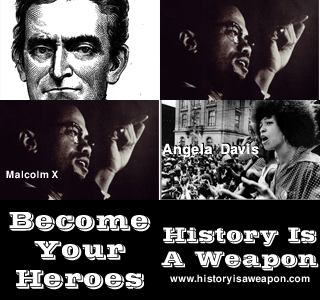
At History is a Weapon a brief audit of the role of bias in history begins, "History isn't what happened, but a story of what happened." That much should be obvious, but is worth hearing from time to time. The audit offers quick entry into some of the central questions of historiography, and stands as the welcome page to a website that presents scanned versions of several texts, including A People's History of the United States. History is a Weapon describes itself as "an online Left reader focusing largely on American resistance history." I think that's an accurate assessment for a site that is a terrific resource.

I've added a link under "American History Links."

History Is A Weapon

31 March 2008

Vertigo and the Sublime

I never read one book, but always have a half dozen or more going at once. I read some books in particular places, and carry others until I’m through with them. I have stacks of partly read books scattered from nightstand to throne room. I read much of Paul Schullery’s Cowboy Trout on several fishing trips last summer, and will finish it during the first or second angling expedition in the next month or so. I read most of Barry Miles, Zappa: A Biography last fall and eventually will read the last twenty pages. I’m in for the long haul on my readings of A Patriot’s History of the United States by Larry Schweikart and Michael Allen, A History of the American People by Paul Johnson, and A People’s History of the United States by Howard Zinn, which I’ve read previously. I could finish Dreams from my Father by Barack Obama today or tomorrow, but it might sit unopened for another week or so, as it has for the past several days. Due to my “Reading Challenge,” I’m going through Jorge Luis Borges, Selected Non-Fictions systematically at a page or two per day.

A few days ago, I started William Peden’s critical edition of Notes on the State of Virginia by Thomas Jefferson (Chapel Hill: University of North Carolina Press, 1982 [1954]). Jefferson writes about a sublime natural feature on some land that he purchased.

The arch approaches the Semi-elliptical form; but the larger axis of the ellipsis, which would be the cord of the arch, is many times longer than the {semi-axis which gives it’s height.} Though the sides of this bridge are provided in some parts with a parapet of fixed rocks, yet few men have resolution to walk to them and look over into the abyss. You involuntarily fall on your hands and feet, creep to the parapet and peep over it. Looking down from this height about a minute, gave me a violent head ache. {This painful sensation is relieved by a short, but pleasing view of the Blue ridge along the fissure downwards, and upwards by that of the Short hills, which, with the Purgatory mountain is a divergence from the North ridge; and descending then to the valley below, the sensation becomes delightful in the extreme. It is impossible for the emotions, arising from the sublime, to be felt beyond what they are here: so beautiful an arch, so elevated, so light, and springing, as it were, up to heaven, the rapture of the Spectator is really indiscribable! The fissure continues deep and narrow and, following the margin of the stream upwards about three eights of a mile you arrive at a limestone cavern, less remarkable, however, for height and extent than those before described. It’s entrance into the hill is but a few feet above the bed of the stream.}
Jefferson, Notes on the State of Virginia, 24-25.

This version of the text differs from that found on the American Studies Crossroads Project’s hypertext version, which used an edition printed in Brooklyn by the New York Historical Printing Club in 1894. Notes on the State of Virginia was published without Jefferson’s name in France in 1785, then with his name by John Stockdale in England in 1787. The Stockdale edition became the definitive text, but Jefferson inscribed marginal corrections in his personal copy throughout the rest of his life. This marginalia is the basis for the deviations from the Stockdale edition that Peden enclosed in brackets.

Peden’s notes include Jefferson’s marginal comment.

This description was written after a lapse of several years from the time of my visit to the bridge, and under an error of recollection which requires apology. For it is from the bridge itself that the mountains are visible both ways, and not from the bottom of the fissure as my impression then was. The statement therefore in the former edition needs the corrections here given to it. Aug. 16. 1817.
Jefferson, Notes on the State of Virginia, 263.

Peden includes the Stockdale version in the balance of this endnote.

I suspect that Peden’s misspelling of “its” in two instances reflects changes in American English from the 1950s to today.

24 January 2008

Becker and Everyman 1932

Irreducible Bias

In his presidential address to the American Historical Association in 1931, Carl Becker stated in part:

Even the most disinterested historian has at least one preconception, which is the fixed idea that he has none. The facts of history are already set forth, implicitly, in the sources; and the historian who could restate without reshaping them would, by submerging and suffocating the mind in diffuse existence, accomplish the superfluous task of depriving human experience of all significance. Left to themselves, the facts do not speak; left to themselves they do not exist, not really, since for all practical purposes there is no fact until someone affirms it.
Becker, "Everyman his own Historian," American Historical Review (1932), 233.

11 January 2008

Indian Population 1492: John D. Daniels

Praise and Expectations

At first glance John D. Daniels, “The Indian Population of North America in 1492,” William and Mary Quartery (April 1992), 298-320, is an impressive article that deserves praise as “[t]he best single review of all the literature on Indian population numbers” (Schweikart and Allen, A Patriot’s History, 9). It offers a staggering list of citations, boiling down many articles and books to three or four sentence summaries of general method to identify “eleven methods,” one “expedient,” and “three schools of thought”. He states, “conflict among them culminated in a major controversy that involved far more than numbers” (298).

These three schools of thought developed chronologically from low to higher estimates. Bottom up dominated 1910-1955 and produced “estimates in the 500,000 to 2,500,000 range” (310). Area modeling “came to prevail from the mid-1950s to the mid-1980s” (312), with estimates in the range “2,500,000 to 7,000,000” (310). The top down school originated with a 1966 article by Henry Dobyns, and offers estimates from “7,000,000 to 18,000,000” (310); it “gradually displaced area modeling, achieving dominance by the mid-1980s” (314).

The most influential members of bottom up school are James Mooney and Alfred Kroeber. They estimate each tribe individually, and add all estimates to achieve their totals. Area modeling is the name employed by Daniels for the work of Sherburne Cook, Harold Driver, and others that develop ecological and cultural models of areas; such factors as population density and resource availability form the base for their estimates. The top down method was initiated by Henry Dobyns who employed epidemic correction, carrying capacity, multiple multiple, and depopulation ratio multiplied by actual census data of nadir population. Although others have arrived at lower estimates, while his continued to climb, many have adopted his methods.

The crux of the problem, as Daniels sees it, stems from “the inadequacy of historical evidence” because reports by colonial Europeans “are invariably defective” (298). In order to compensate for gaps and issues of credibility in the documentary record, sophisticated methods of estimation have been developed. Daniels concludes:

Despite all the discussion of rules of evidence and logic, no one has attempted tribe-by-tribe analysis, taking all direct evidence seriously and using simple inference only when absolutely essential. In order to create a reliable estimate of the North American population in 1492, scholars will either have to find new evidence or develop better methods of handling evidence.
Daniels, “Indian Population,” 320.

From such assertions, we might expect some detailed analysis of representative primary sources to illustrate how they are “defective”. We also might expect further assessment of how particular methodologies have employed such “direct evidence,” and some explanation regarding when inference is essential. It goes without saying that Daniels’ own use of evidence should prove exemplary.

Disappointment

These expectations produce disappointment. Daniels does not cite or analyze a single primary source. Rather, he assesses the interpretation of primary sources in secondary literature through that literature alone. In contrast, much of the literature reviewed by Daniels works through and argues about a wealth of such sources. Even a look through that literature reveals telling inconsistencies in his elaboration of historiography.

He identifies “report discounting” and “guesstimates” among the methods employed by Mooney, Kroeber, and others of the “bottom up” school. Daniels notes regarding guesstimates, “critics can assess reliability only when the guesser explains the reasoning behind the estimate” (304-305). Report discounting calls for comparable scrutiny, but instead Daniels shifts the emphasis: “Some scholars have scathingly rejected this procedure, defending the value of primary sources and accusing the discounters of cultural and racial bias” (306). Later he highlights cultural concerns:

[Critics of Mooney and Kroeber] alleged that prejudice and a desire to make Indians appear insignificant led to deliberate discounting of evidence of large early native populations. …
Some critics began to wonder if Henry Dobyns and his followers were just as biased in favor of the Indians as Mooney and Kroeber supposedly had been against them.
Daniels, “Indian Population,” 317-318.

He wears the mask of objectivity through careful attribution to others of this binary:

anti-Indian = low estimate / pro-Indian = high estimate

However, he reveals his face by defending Mooney and Kroeber against attacks he feels are unjustified: “since they had spent much of their lives documenting the surviving Indian cultures, they probably would have regarded the charge of cultural bias as absurd” (318). After cultural issues came into academic debates:

The second issue involves the principles of evidence and reasoning. The bottom-up approach is essentially historical; it admits only direct primary evidence and uses only simple deductive logic involving evaluation and comparison of reported data. The school rejects all forms of inference except by simple analogy.
Daniels, “Indian Population,” 318.


Daniels’s Apologia for Discounting

Daniels seizes several opportunities to commend the work of the “bottom up” school because “[t]hey normally used whatever direct historical evidence was available” (316). On the other hand, “area modelers had loosened the rules of evidence and logic” (319). Such “loosening” opened the door for Dobyns’s “radical departure at which the work of others had only hinted” (314).

This “radical departure” was first proposed in “Estimating Aboriginal Population: An Appraisal of Techniques with a New Hemispheric Estimate,” Current Anthropology (Sept. 1966), 395-416. Inasmuch as Dobyns raises significant methodological points against Mooney, Kroeber, and those that popularized their estimates, it is worth looking more closely at his arguments. He mentions as a case in point a figure of eight million Indians perishing in the Caribbean and Peru that was put forth in 1685 by the Marques de Varina to dispute the contentions of others that mining operations were the principle cause of Indian depopulation in Spanish colonies. Dobyns admits that such figures might have been inflated, but cautions against the wholesale discounting of the “bottom up” school.

To make such an assumption does not entitle the analyst to discard those figures; it does require him to seek corroborative or negating evidence. Rosenblat, Kroeber and their imitators have not done so. Their characteristic methodology has included depreciation of all historical population figures. They deprecate the departure of historical witnesses from the "truth" for motives they intuitively impute, but which uniformly led said witnesses to overestimate, in their opinion, aboriginal populations. They ignore the fact that eyewitnesses, whatever their biases, at least observed population trends which the modern analyst can never witness.
Dobyns, “Estimating Aboriginal Population,” 398.

Nowhere in “The Indian Population of North America” does John Daniels discuss how the scholarly methods that he names reveal efforts to corroborate or negate the evidence contained in colonial accounts. Yet, such assessment of historical documents is at the heart of the conception of historiography that he assumes.

New England Case Study

Henry Dobyns asserts in Their Number Become Thinned (1983) and other works that the smallpox epidemic that afflicted Mexico during its conquest by Hernán Cortés may have spread as a continent wide pandemic. He then draws upon a letter from Roger Williams to John Winthrop to offer documentary evidence for sixteenth century epidemics among the Narragansett (Dobyns, 318-319). Dean R. Snow and Kim M. Lanphear dispute his contention in several works, including “European Contact and Indian Depopulation in the Northeast: The Timing of the First Epidemics,” Ethnohistory (Winter 1988), 15-33. They review available Spanish sources, stating that “evidence suggests that epidemics did not spread northward from Mexico” (17). Then they turn toward the Northeast and offer a careful examination of the Williams letter and Dobyns use of it. They find other documents contradict Williams, or at least Dobyns's reading of him.

They contend that the first epidemic to hit New England arrived in 1616. It may have been the bubonic plague, or it may have been yellow fever or trichinosis. In any case, they find wanting the evidence that it reached the interior, although it clearly devastated the coast from Maine to Massachusetts. There is no dispute that an epidemic struck the coast of New England before the English established their colony there. There is considerable debate regarding its extent—epidemic or pandemic—and whether it was the first.

Daniels’ assertion—citing earlier work by Dean R. Snow—thus seems terribly misleading:

[According to some] major epidemics of Old World diseases preceded European explorers by a few years or decades and killed a significant percentage of the native population. … Some authorities maintain, for example, that a serious epidemic hit the Northeast before the first English settlers arrived.
Daniels, “Indian Population,” 306.

Although it is not cited by Snow and Lanphear, Mourt's Relation corroborates their recognition that an epidemic swept the coast of New England in 1616. The document was written principally by Edward Winslow and published in London in 1622. It is one of the key primary sources for the history of the Pilgrims in what later came to be called New England. The entire text with modernized spellings is accessible online at The Plymouth Colony Archive Project.

Two excerpts:

So we light on a path, but saw no house, and followed a great way into the woods. At length we found where corn had been set, but not that year. Anon we found a great burying place, one part whereof was encompassed with a large palisade, like a churchyard, with young spires for or five yards long, set as close one by another as they could, two or three feet in the ground. Within it was full of graves, some bigger and some less; some were also paled about, and others had like an Indian house made over them, but not matted. Those graves were more sumptuous than those at Cornhill, yet we digged none of them up, but only viewed them, and went our way. Without the palisade were graves also, but not so costly. From this place we went and found more corn-ground, but not of this year. As we ranged we light on four or five Indian houses, which had been lately dwelt in, but they were uncovered, and had no mats about them, else they were like those we found at Cornhill but had not been so lately dwelt in. There was nothing left but two or three pieces of old mats, and a little sedge. Also, a little further we found two baskets full of parched acorns hid in the ground, which we supposed had been corn when we began to dig the same; we cast earth thereon again and went our way. All this while we saw no people.
Mourt’s Relation

About noon we met again about our public business, but we had scarce been an hour together, but Samoset came again, and Tisquantum, the only native of Patuxet, where we now inhabit, who was one of the twenty captives that by Hunt were carried away, and had been in England.
Mourt’s Relation


The Pilgrim records are clear that Tisquantum (Squanto) was the only survivor of his home village and that abandoned villages were present throughout the region. Although there are several possible explanations for abandoned villages, disease was certainly one cause prior to English settlement in the Northeast.

Assessment

Daniels’ seminal article is nearly comprehensive, but terribly superficial in its review. Its convoluted scheme to organize a mass of scholarship gets cited, but not embraced in subsequent scholarship. His footnotes offer a useful point of entry into the field of pre-Columbian demography, but an alphabetized bibliography might serve just as well. His analysis offers a few useful questions, but no credible answers. The entire article seems to be a thinly disguised defense of the lowest estimates—the lack of credibility of which is the starting point for all scholarship in the field.

A far better review of the literature is available in Russell Thornton, “Aboriginal North American Population and Rates, ca. A.D. 1500-1900,” Current Anthropology (April 1997), 310-315. Thornton’s article, as Daniels, is not without an agenda. Thornton’s concern emphasizes the interplay of disease with other aspects of colonialism to produce long-term population decline for the indigenous population of the Americas from initial contact through the nineteenth century. His 1997 summary is broader in scope and less comprehensive than Daniels, but its summary of the themes and contentious issues in the scholarship presents a far more credible overview. The failure of Schweikart and Allen, A Patriot’s History, to mention Thornton while they praise Daniels is but one indication that their claims rest upon shoddy scholarship.

Daniels’s article might appear to be the source for the statement: “One recent scholar, examining the major assessments of the numbers, points to at least nine different measurement methods, including the time-worn favorite, guesstimates” (Schweikart and Allen, 8). This sentence neither rests upon Daniels’ identification of eleven methods, nor upon his observation that count multiple “has been used more than any other” (305), but it otherwise bears a strong similarity to his thesis. In any case, we can apply Daniels’s scheme to some of the numbers in A Patriot’s History. Daniels explains that the method he calls depopulation ratio (DR) assumes the significance of disease, so scholars start from a nadir population that is usually reasonably certain; then they multiply. Ratios have ranged “between 5:1 and 25:1 and nadirs for North America from 1870 to 1930” (308).

Schweikart and Allen both assert and conclude a depopulation ratio (DR) near 1:2. They state that 56 million deaths, as some have alleged, requires an aboriginal population of 100 million (56% depopulation). Then by rounding Ubelaker’s 1,894,350 down to 1.8 million, they state 800,000 died (50% depopulation). I’ve already noted in “Depopulation: Ubelaker’s Low Estimate” that Ubelaker’s own figures include nearly 1.4 million dead (72% depopulation). It would seem that Schweikart and Allen have reversed Dobyns’s most controversial process, applying a ratio of 1:2 to the lowest available estimate after rounding it down. Such numbers are dishonest.

17 December 2007

Firearms and Bows 1607: The Jamestown Test

The colonists at Jamestown set up a test to compare their weapons to those of the Indians. Less than a month after the colonists arrived in Virginia, and only a few days after they began constructing the defensive fortifications to give them security in a potentially hostile land, they became the recipients of food brought by forty men from the Native village headed by Paspiha. George Percy, who was there, mentions that the British thought the generosity was part of a ruse to disarm them. A weapons test was conducted during this visit of the Powhatans to the English village.

Charles C. Mann, 1491: New Revelations of the Americas before Columbus mentions this episode:
Even for a crack shot, a seventeenth-century gun had fewer advantages over a longbow than may be supposed. Colonists in Jamestown taunted the Powhatan in 1607 with a target they believed impervious to an arrow shot. To the colonists’ dismay, an Indian sank an arrow into it a foot deep, “which was strange, being that a Pistoll could not piece it.” To regain the upper hand, the English set up a target made of steel. This time the archer “burst his arrow all to pieces.” The Indian was “in a great rage”: he realized, one assumes, that the foreigners had cheated. When the Powhatan later captured John Smith, [Joyce] Chaplin notes, Smith broke his pistol rather than reveal to his captors “the awful truth that it could not shoot as far as an arrow could fly.”
Mann, 1491, 64.
I mentioned in “Superior European Technology” Mann’s suggestion that the terms superior and inferior do not readily apply to the differences in the technology of the immigrants and the indigenous inhabitants of the land that was coming to be called Virginia.


George Percy’s Account

Some of the primary sources that aid historians in reconstructing the founding of Virginia are found in an early anthology of travel narratives collected and published by Richard Hakluyt and Samuel Purchas, Hakluytus Posthumus or Purchas his Pilgrimes, contayning a History of the World in Sea Voyages and Lande Travells, by Englishmen and others , 4 vols (1625). This anthology contains an account of the first months of the Virginia colony, George Percy, “Observations gathered out of a Discourse of the Plantation of the Southerne Colonie in Virginia by the English, 1606,” in Purchas his Pilgrims, vol. 4 (1625), 1685-1690.


Percy relates the episode that Mann draws upon for evidence supporting his generalizations regarding technology.
The twentieth day [20 May 1607] the Werowance of Paspiha sent fortie of his men with a Deere, to our quarter: but they came more in villanie than any love they bare us: they faine would have layne in our Fort all night, but wee would not suffer them for feare of their treachery. One of our Gentlemen having a Target which hee trusted in, thinking it would beare out a slight shot, he set it up against a tree, willing one of the Savages to shoot; who took from his backe an Arrow of an elle long, drew it strongly in his Bowe, shoots the Target a foote thorow, or better: which was strange, being that a Pistoll could not pierce it. Wee seeing the force of his Bowe, afterwards set him up a steel Target; he shot again, and burst his arrow all to pieces, he presently pulled out another Arrow, and bit it in his teeth, and seemed to be in great rage, so he went away in great anger. Their Bowes are made of tough Hasell, their strings of Leather, their Arrowes of Canes or Hasell, headed with very sharpe stones, and are made artificially like a broad Arrow: other some of their Arrowes are headed with the ends of Deeres hornes, and are feathered very artificially. Pasphia was as good as his word; for he sent Venison, but the Sawse came within a few dayes after.
Percy, “Discourse of the Plantation of the Southerne Colonie,” 1688-1689.

First Battle between Jamestown Colonists and Natives

In late April, before the colonists had selected the location for their fort, their first encounter with the Natives of Virginia was hostile.
At night, when wee were going aboard, there came the Savages creeping upon all foure, from the Hills like Beares, with their Bowes in their mouthes, charged us very desperately in the faces, hurt Captaine Gabrill Archer in both his hands, and a sayler in two places of the body very dangerous. After they had spent their Arrows, and felt the sharpness of our shot, they retired into the Woods with a great noise, and so left us.
Percy, “Discourse of the Plantation of the Southerne Colonie,” 1686.
After this skirmish, the English resumed their exploration of the terrain. Percy presents lists of the flora and fauna observed; he describes the shores and rivers, the meadows and forests, and other brief experiences with the Natives. They found an area where the Natives of Virginia had been burning the grass, as well as gathering and roasting oysters. Helping themselves to the warm oysters in the recently abandoned camp, the English found the shellfish “large and delicate in taste” (1686). They also found “a Cannow, which was made out of the whole tree, which was five and fortie foot long by the Rule” (1686).


Peaceful Contact

The English set up a cross to claim Chesapeake Bay for the Crown and named a piece of land Cape Henry. On the last day of April they were drawn into a Native village, where they were welcomed with songs, given a meal and smoke, and then entertained with songs and dances. They learned something of the manners of their hosts. In the narrative of the experiences, George Percy (sometimes spelled Percie) reveals quite a bit about the ideological baggage that colored English perceptions of Native American Indians.
When we came over to the other side, there was a many of the Savages which directed us to their Towne, where we were entertained by them very kindly. When we came first a Land they made a dolefull noise, laying their faces to the ground, scatching the earth wth their nailes. We did thinke that they had beene at their Idolatry. When they had ended their Ceremonies, they went into their houses and brought out mats and laid upon the the ground, the chiefest of the sate all in a rank: the meanest sort brought us such dainties as they had, & of their bread which they make of their Maiz or Gennea wheat, they would not suffer us to eat unlesse we sate down, which we did on a Mat right against them. After we were well satisfied they gave us of their Tabacco, which they tooke in a pipe made artificially of earth as ours are, but far bigger, with the bowle fashioned together with a piece of fine copper. After they had feasted us, they shewed us in welcome, their manner of dancing, which was in this fashion: one of the Savages standing in the midst singing, beat one hand against another, all the rest dancing about him, shouting, howling, and stamping against the ground, with many Anticke tricks and faces, making noise like so many Wolves or Devils. One thing of them I observed; when they were in their dance they kept stroke with their feet just one with another, but with their hands, heads, faces, and bodies, every one of them had a severall gesture: so they continued for the space of halfe an houre. When they had ended their dance, the Captaine gave them Beades and other trifling Jewells. They hand through their eares Fowles legs: they shave the right side of their heads with a shell, the left side they weare of an ell long tied up with an artificiall knot, with a many of Foules feathers sticking in it. They goe altogether naked, but their privates are covered with Beasts skinnes beset commonly with little bones, or beasts teeth: some paint their bodies blacke, some red, with artificiall knots of sundry lively colours, very beautiful and pleasing to the eye, in a braver fashion then they in the West Indies.
Percy, “Discourse of the Plantation of the Southerne Colonie,” 1687

The entire text of Purchas his Pilgrimes is available at the Library of Congress website, where it is part of the Kraus Collection of Sir Francis Drake. Each page of the four volumes has been photographed, including black pages, and is viewable as an image.

11 December 2007

History News Network

I've just discovered that the History News Network has added this site to their extensive blogroll of history weblogs. Their extensive list is well worth a glance through for anyone interested in the past and its influence over the present and future.

My thanks also go out to Jon Swift, the first to blogroll me; Doghouse Riley, who offered a nice recommendation; D. Cupples at Buck Naked Politics; and the blogger of Dancing with Myself. Thanks to all.

  © Blogger templates The Professional Template by Ourblogtemplates.com 2008

Back to TOP