


I've been neglecting my work on A Patriot's History of the United States and A People's History of the United States this fall due to preoccupation with other matters, but I have not entirely forgotten this blog. For my two or three loyal readers anxiously waiting for more output, I can offer only links to two tidbits of heart-warming cheer.
Bob Dylan's "Must be Santa" from YouTube (thanks to Roxanne Dunbar-Ortiz for sharing the link)
Rick Perlstein's "The 1960s, Refracted," published yesterday in The American Prospect.
17 December 2009

29 November 2009
Cursed Hops
Ezra Meeker was a pioneer in developing the agriculture of Washington state, including the first hops. Today, there are no hops grown in western Washington, but the Yakima Valley grows more than 70% of US hops, and accounts for 1/4 of the world's production. See "Crop Profile for Hops in Washington" (1999).
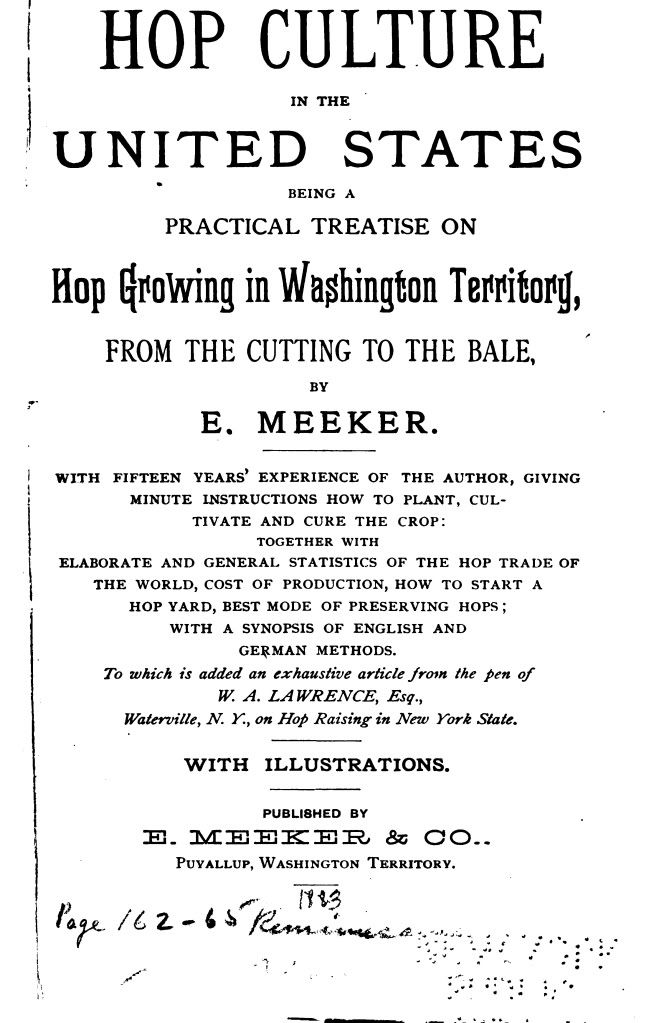
Hops have one use: making beer. Not surprisingly, churches that were active in the movement advocating Prohibition celebrated the insect infestation that destroyed hops in western Washington in the late nineteenth century. A letter Ezra Meeker sent to the Seattle Post-Intelligencer in September, 1895 reveals cultural and ideological faultlines. Meeker reprinted the letter in Ventures and Adventures of Ezra Meeker (1909).
Hops have one use: making beer. Not surprisingly, churches that were active in the movement advocating Prohibition celebrated the insect infestation that destroyed hops in western Washington in the late nineteenth century. A letter Ezra Meeker sent to the Seattle Post-Intelligencer in September, 1895 reveals cultural and ideological faultlines. Meeker reprinted the letter in Ventures and Adventures of Ezra Meeker (1909).
To the Editor:Meeker points out that his hops failed nevertheless, and that he did not get back his $400.
In this morning's reprt of the Methodist conference I notice under the heading "A Curse on the Hop Crop," that Preacher Hanson, of Puyallup, reported he had some good news from that great hop country--the hop crop, the main support of the people was a failure; the crop had been cursed by God. Whereupon Bishop Bowman said "Good" and from all over the room voices could be heard giving utterance to the fervent ejaculation, "Thank God."
For the edification of the reverend fathers and fervent brethren I wish to publish to them and to the world that I have beat God, for I have 500 acres of hops at Puyallup and Kent that are free from lice, the "curse of God," and that I believe it was the work of an emulsion of whale oil soap and quassie sprayed on the vines that thwarted God's purpose to "curse" me and others who exterminated the lice.
One is almost ready to ask if this is indeed the nineteenth century of enlightenment, to hear such utterances gravely made by men supposed to be expounders of that great religion of love as promulgated by the Great Teacher.
I want to recall to the memory of the Rev. Mr. Hanson that the church in which he has been preaching for a year past was built in great part by money contributed from gains of this business "Cursed by God." For myself I can inform him that, as a citizen of Puyallup, I contributed $400 to buy the ground upon which that edifice is built, every cent of which came from this same hop business "cursed by God." I would "thank God" if they would return the money and thus ease their guilty consciences.
Ezra Meeker
(Ventures and Adventures, 288-289)
09 November 2009
Thinking Historically with Adult Students
(This post began as a response to the first in a series concerning Sam Wineburg, Historical Thinking and Other Unnatural Acts (2001) on John Fea's blog: The Way of Improvement Leads Home, "Historical Thinking and Other Unnatural Acts--Part One.")
I teach adult students--minimum age is 25--in six week classes that usually meet twice per week for 3 1/2 hours (there's an option of once per week and two eight-hour Saturdays). I lecture too much in these classes. The lectures give me a sore throat, and are grueling endurance tests for the students, but they also stimulate innovative uses of PowerPoint.
A new class begins tonight: Pacific Northwest History. My usual first week lectures include a 42 slide presentation ("Inventing a Hinterland") and another 60 slide presentation ("Historiography and Colonization"). Both presentations offer up some gems, but can be deadly if I fail to engage the students in thinking historically.
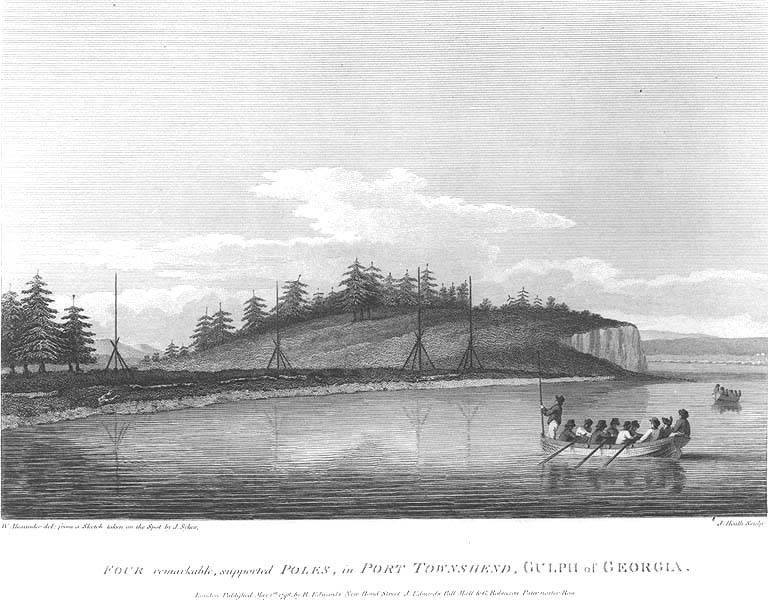
I tend to get some mileage from images and text from George Vancouver's journal concerning some enigmatic poles. Vancouver died failing to comprehend their purpose, and I reveal the findings of ethnography only after considerable effort on the part of the students to comprehend their purpose from Vancouver's descriptions.
In the past, I have presented an extract from the pen of Captain James Cook as a photocopy with the title "hostilities expected":
Even the name Nootka stems from misunderstanding. A separate handout has this passage alongside another from the same source. I label them "Nuu-chah-nulth orature".
Tonight, students are receiving as photocopies the chapter in Cook's A Voyage to the Pacific Ocean (1784) from which this passage is extracted. They are also receiving the Sound Heritage article "The Contact Period as Recorded by Indian Oral Traditions," edited by Barbara S. Erfrat and W.J. Langlois that was Ruth Kirk's source for the brief extracts in her book.
When we meet for the second time, Wednesday, I will expect that they have read these twenty-five pages and written half a dozen questions that require research to answer.
My plan tonight is to start with the questions:
1. What is history?
2. Why does history merit our attention?
3. What are the boundaries of the Pacific Northwest?
All of these questions are addressed to an extent in my PowerPoint presentations, which we may or may not get to.
I teach adult students--minimum age is 25--in six week classes that usually meet twice per week for 3 1/2 hours (there's an option of once per week and two eight-hour Saturdays). I lecture too much in these classes. The lectures give me a sore throat, and are grueling endurance tests for the students, but they also stimulate innovative uses of PowerPoint.
A new class begins tonight: Pacific Northwest History. My usual first week lectures include a 42 slide presentation ("Inventing a Hinterland") and another 60 slide presentation ("Historiography and Colonization"). Both presentations offer up some gems, but can be deadly if I fail to engage the students in thinking historically.
I tend to get some mileage from images and text from George Vancouver's journal concerning some enigmatic poles. Vancouver died failing to comprehend their purpose, and I reveal the findings of ethnography only after considerable effort on the part of the students to comprehend their purpose from Vancouver's descriptions.
In the past, I have presented an extract from the pen of Captain James Cook as a photocopy with the title "hostilities expected":
During these visits they gave us no other trouble than to guard against their thievish tricks. In the morning of the 4th we had a serious alarm. Our party on shore, who were employed in cutting wood and getting water, observed that the natives all around them were arming themselves in the best manner they could, those who were not possessed of proper weapons preparing sticks and collecting stones. On hearing this I thought it prudent to arm also, but, being determined to act upon the defensive, I ordered our workmen to retreat to the rock upon which we had placed our observatories, leaving the natives in quiet possession of the ground. Our fears were ill- grounded. These hostile preparations were not directed against us, but against a body of their own countrymen, who were coming to fight them; and our friends of the sound, on observing our apprehensions, used their best endeavors to convince us that this was the case. We could see that they had people looking out on each point of the cove, and canoes frequently passed between them and the main body assembled near the ships. At length the adverse party, in about a dozen large canoes, appeared off the south point of the cove, when they stopped, and lay drawn up in a line of battle, a negotiation having commenced. Some people in canoes, in conducting the treaty, passed between the two parties, and there was some speaking on both sides. At length the difference, whatever it was, seemed to be compromised, but the strangers were not allowed to come alongside the ships, not to have any trade or intercourse with us. (Italics added)It is a remarkable passage that should provoke a number of useful questions. I like to highlight the potential for miscommunication and misunderstanding. The novelty of Northwest Coast social and economic conventions, not yet understood by Cook and his crew (and probably not much understood at the end of their month in Nootka Sound) become evident in the expectations of attack when their "friends" are arming themselves against "strangers". Yet, Cook almost seems to comprehend that control of international trade was a central motivation for the threat of hostilities.
James Cook, Captain Cook’s Voyages Round the World (1897), 427
Even the name Nootka stems from misunderstanding. A separate handout has this passage alongside another from the same source. I label them "Nuu-chah-nulth orature".
So, the Chief told them to go out there again and see, you know. … They started making signs and they were talking and they were saying, ‘Nu-tka-icum.’ ‘Nu-tka- icum,’ they were saying. That means, ‘You go around the harbour [to find better anchorage].’ So Captain Cook said, ‘Oh. They’re telling us the name of this place is Nootka.’ That’s how Nootka got its name.I generally try to get the students to frame some historical questions stemming from these passages. In place of their own questions, they usually leave with some of my generalizations about mutually beneficial trade and the failures on intercultural communication.
… But the Indian name is altogether different. …
We call white people ‘Muh-mul-ni’ because … they came in boats that looked high and strange to us, and muh-mul- ni means ‘houses on the water.’ Those people seemed to be in houses floating on the water.”
Mrs. Winnifred David, Sound Heritage, vol. 7 (1978); quoted in Ruth Kirk, Tradition and Change on the Northwest Coast (1986), 201
Tonight, students are receiving as photocopies the chapter in Cook's A Voyage to the Pacific Ocean (1784) from which this passage is extracted. They are also receiving the Sound Heritage article "The Contact Period as Recorded by Indian Oral Traditions," edited by Barbara S. Erfrat and W.J. Langlois that was Ruth Kirk's source for the brief extracts in her book.
When we meet for the second time, Wednesday, I will expect that they have read these twenty-five pages and written half a dozen questions that require research to answer.
My plan tonight is to start with the questions:
1. What is history?
2. Why does history merit our attention?
3. What are the boundaries of the Pacific Northwest?
All of these questions are addressed to an extent in my PowerPoint presentations, which we may or may not get to.
30 September 2009
Getting it Right
Still working on an article that no one will ever read for an encyclopedia that no one will ever buy, I just came across a few marvelous articles on the Blackfeet Nation's newly designed website. Last week, the site had a modest welcome page and no links. Today, the site seems almost complete.
The writing about Blackfeet history is fresh, fervent, and perhaps well-described as Blackfeet Nationalist. Under "Our History," the site offers an article, "We Come From Right Here." I had to read this as quickly as possible because I've long known that the Piegan Blackfeet insist they have been in Montana 10,000 years, while most books state they were migrating southwest fresh from the Canadian Prairies about the time they fell into a fight with Lewis and Clark on the explorers' return from Oregon in 1806. Some of the history books put the Blackfeet in Montana a century or two before that.
The writing about Blackfeet history is fresh, fervent, and perhaps well-described as Blackfeet Nationalist. Under "Our History," the site offers an article, "We Come From Right Here." I had to read this as quickly as possible because I've long known that the Piegan Blackfeet insist they have been in Montana 10,000 years, while most books state they were migrating southwest fresh from the Canadian Prairies about the time they fell into a fight with Lewis and Clark on the explorers' return from Oregon in 1806. Some of the history books put the Blackfeet in Montana a century or two before that.
But scholars write books and give lectures and huff and puff about times in which they never lived, worlds into which they never stepped foot, and languages they can never hear spoken by the ancients they study. As an example of how little is really known about Indians in the pre-Columbian period, experts can’t even agree if the population of the Americas was 8 million or 112 million. If they know so little that they can’t get within an order of magnitude of each other, why bother guessing about anything else?The link may change, and the text, too. The site is still under construction. Readers of this blog may know what I think of these population figures. If not, click the "depopulation" link below and read away.
"We Come From Right Here"
26 September 2009
Errors of Fact
I'm not blogging much of late because I'm struggling to finish an overdue encyclopedia article that compresses all of Montana Indian history into sixty or so double-spaced typewritten pages. Along the way, I'm reading and rereading every book in my library that bears on the subject, probing the depths of the web, and working JSTOR for all it's worth.
The Error
This morning's coffee goes down with a few pages of light reading in The Lance and the Shield: the Life and Times of Sitting Bull (1993) by Robert M. Utley. It seems fair to say that no one knows more about the military history of the nineteenth century Western frontier than Utley. Indeed, the Western History Association's award for the best book each year concerned with the military history of the frontier is called the Robert M. Utley Book Award.
Imagine my dismay, then, when I read the following sentence:
Connor split his forces into an ambitious three-pronged assault to converge on the Powder River. His orders to his subordinates stated, “You will not receive overtures of peace or submission from Indians but will attack and kill every male Indian over twelve years of age.”* General John Pope, upon learning of these orders, insisted that steps to countermand them be put immediately into action. The Army did not need more bad press of the sort generated in the wake of the brutal Sand Creek Massacre in southeast Colorado. Nevertheless, the expedition continued with Connor’s orders intact.
No friendly Indians were encountered during the campaign, and there were few significant engagements with hostiles. One band of Arapahos was attacked on the Tongue River, losing their winter food stores, clothing, and most of their horses. Several bands of Lakota—Hunkpapas, Blackfeet, Miniconjou, and Sans Arc—harassed Connor’s two eastern columns marching together up the Powder River. The soldiers were well armed and two thousand strong, but were on the verge of starvation, and suffering from the drought. A summer storm brought sudden cold and wet conditions, killing most of the Army’s mules. Further upriver, Oglala led by Red Cloud and Cheyenne led by Little Wolf continued the attacks.
The Army’s efforts seemed to embolden, rather than pacify the Sioux (mostly Lakota), Cheyenne, and Arapaho that had been wresting the area from the Crow, and attacking immigrants. Fort Reno became the first of three forts along the Bozeman Trail that aggravated the Lakota and Cheyenne.
The following summer, troops under the command of Col. Henry B. Carrington built Fort Phil Kearny in Wyoming and Fort C.F. Smith on the Bighorn River in Montana.
If Utley can make such an error, anyone can. Of course, some writers make more errors than others. This sentence stands out in Utley's work because it is rare.
*H. D. Hampton, “The Powder River Expedition 1865,” Montana: The Magazine of Western History 14 (Autumn 1964): 8-9.
The Error
This morning's coffee goes down with a few pages of light reading in The Lance and the Shield: the Life and Times of Sitting Bull (1993) by Robert M. Utley. It seems fair to say that no one knows more about the military history of the nineteenth century Western frontier than Utley. Indeed, the Western History Association's award for the best book each year concerned with the military history of the frontier is called the Robert M. Utley Book Award.
Imagine my dismay, then, when I read the following sentence:
In the summer of 1866 the army built three posts along the Bozeman Trail: Forts Reno, Phil Kearny, and C.F. Smith.In 1865, the U.S. Army sent General Patrick Edward Connor’s Powder River Expedition into northeast Wyoming and southeast Montana with hopes of pacifying the Indians who resented travel through their hunting lands. The expedition established Fort Connor in August 1865 (renamed Fort Reno in November 1865) on the upper Powder River in Wyoming, and then left the region.
Utley, The Lance and the Shield, 71
Connor split his forces into an ambitious three-pronged assault to converge on the Powder River. His orders to his subordinates stated, “You will not receive overtures of peace or submission from Indians but will attack and kill every male Indian over twelve years of age.”* General John Pope, upon learning of these orders, insisted that steps to countermand them be put immediately into action. The Army did not need more bad press of the sort generated in the wake of the brutal Sand Creek Massacre in southeast Colorado. Nevertheless, the expedition continued with Connor’s orders intact.
No friendly Indians were encountered during the campaign, and there were few significant engagements with hostiles. One band of Arapahos was attacked on the Tongue River, losing their winter food stores, clothing, and most of their horses. Several bands of Lakota—Hunkpapas, Blackfeet, Miniconjou, and Sans Arc—harassed Connor’s two eastern columns marching together up the Powder River. The soldiers were well armed and two thousand strong, but were on the verge of starvation, and suffering from the drought. A summer storm brought sudden cold and wet conditions, killing most of the Army’s mules. Further upriver, Oglala led by Red Cloud and Cheyenne led by Little Wolf continued the attacks.
The Army’s efforts seemed to embolden, rather than pacify the Sioux (mostly Lakota), Cheyenne, and Arapaho that had been wresting the area from the Crow, and attacking immigrants. Fort Reno became the first of three forts along the Bozeman Trail that aggravated the Lakota and Cheyenne.
The following summer, troops under the command of Col. Henry B. Carrington built Fort Phil Kearny in Wyoming and Fort C.F. Smith on the Bighorn River in Montana.
If Utley can make such an error, anyone can. Of course, some writers make more errors than others. This sentence stands out in Utley's work because it is rare.
*H. D. Hampton, “The Powder River Expedition 1865,” Montana: The Magazine of Western History 14 (Autumn 1964): 8-9.
Subscribe to:
Posts (Atom)
